Pandit | Mainland and Islands
A Hindu Priest in Greece: Arranging the Vivāha
The practical side of engaging a Hindu priest in Greece: how the Pandit reaches a clifftop villa or a mainland estate, what the sacred fire needs at a Greek venue, the legal step, the season, and the questions worth asking before you commit.
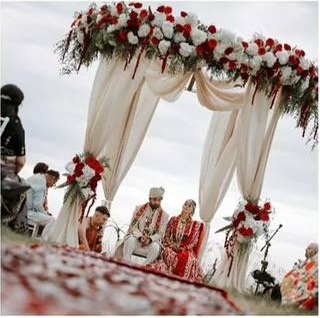
The mandap raised on a Greek hillside, guests gathered and the rite under way.
Most couples searching for a Hindu priest in Greece are not asking a doctrinal question. They have chosen, or are close to choosing, a villa above the Santorini caldera, an estate on Crete, a seaside property in the Cyclades, or a venue near Athens, and they need to know how a properly trained Pandit actually gets there, what he will need on the day, and what they must settle in advance for the rite to run without trouble. This page answers exactly that. The meaning of the Vivāha and why it holds whole on Greek ground are treated separately, in the account of the wedding as a Saṃskāra; here the concern is the logistics, written for the couple in the middle of planning.
How the Priest Reaches Your Venue
Greece spreads a wedding across water, and the single most important logistical fact is that the priest must be brought to the venue with time to prepare, not landed an hour before the guests. For an island wedding on Santorini, Mykonos, or the smaller Cyclades, that means a flight into Athens and a short connecting flight or a ferry to the island, and it means building a day of margin into the schedule so that a delayed ferry or a cancelled hop, both common in high summer, cannot threaten the ceremony. For a mainland or near-Athens venue the travel is simpler, a drive from the capital, but the principle holds: the Pandit arrives the day before where the schedule allows, settles the materials, and inspects the space for the fire before anyone gathers.
For couples coming from across Europe and beyond, the cleanest arrangement is usually to fix the priest’s travel at the same time as the principal guests’ travel, through the same Athens gateway, so that everyone converges on the island together and the timing is known well in advance. Ferries and island flights fill early in July and August; block-booking the priest’s passage along with the family’s is worth the small effort, since a wedding cannot wait on a sold-out boat. None of this is difficult once it is planned; it simply must be planned, in writing, months ahead rather than improvised in the final weeks.
On a coast strung across islands, the priest’s passage is part of the plan, not an afterthought. Bring him to the ground with a day to prepare it.
The Sacred Fire at a Greek Venue
The fire is the heart of the rite and the detail most often left dangerously late. Greek venues handle it well once the right questions are put, but the questions differ by setting. A clifftop terrace on Santorini or Mykonos is open to the meltemi, the dry north wind that strengthens through the afternoon from June to September, so on such a terrace the fire wants a sheltered placement and a vessel the wind cannot disturb, and the priest will read the day and set the canopy to break the gusts. A walled garden, a courtyard, or an olive grove on Crete or the mainland is far calmer and gives the fire an easy home. An indoor or covered space is the steadiest of all but requires the property’s written consent, real ventilation for the smoke, and an agreed safe vessel.
Two cautions specific to Greece are worth holding. First, the southern islands and mainland run a real wildfire risk in the dry heart of summer, and in the worst weeks the local authorities may restrict open flame near vegetation, so a contained vessel set on stone or a cleared paved area, agreed with the venue in advance, is the arrangement that satisfies both the rite and the rules. Second, get the permission in writing before any deposit changes hands, naming both an open-air place and a covered fallback, because the commonest Greek-wedding failure is discovering on a windy afternoon that there is no sheltered alternative. The deeper significance of the fire is set out at Homa and the sacred fire.
Materials, and What the Couple Need Not Worry About
A frequent worry is whether the particular items the rite calls for, the prepared ghee, the grains and sesame for the offerings, the kindling woods, the turmeric and vermilion, the betel and the sacred thread, can be found in Greece. The honest answer is that the couple should not be sourcing these at all. A working Pandit either brings the consumable materials prepared or assembles them through the Indian provisioning of Athens, which is adequate for the essentials, supplementing from elsewhere what an island cannot supply. The flowers and any fresh produce are arranged locally through the wedding’s own florist and caterer, to a short list the priest provides well ahead.
What the couple genuinely need to provide is simpler: the cleared space for the canopy, roughly three to four meters square with the gathering around it; a safe place for the fire as agreed; a low table or platform as the priest directs; and, for the family’s own part, the items of personal and ritual significance that custom asks them to bring, the garments, the rings, the mangalsutra, whatever the two households wish to carry into the rite. A short, clear list exchanged a month ahead removes nearly all of the day’s anxiety, and a Pandit experienced with European weddings will send one as a matter of course.
The Shape of the Day Itself
Couples often ask how the wedding day actually runs once the priest is on the ground, and the answer is reassuringly ordered. The Pandit arrives at the venue well before the guests, usually two hours or more, to lay out the articles, establish the canopy in its agreed place, and prepare the vessel for the fire. This is unhurried, deliberate work, and it is the part of the day on which everything visible afterward depends. Where the family wishes it, the couple may sit with him briefly beforehand so that the sequence is understood rather than met cold.
The rite itself, kept in its full form, runs to around two hours, opening with the invocation and the formal declaration of intent, moving through the giving and the taking of the hand and the offerings into the fire, and completing in the seven steps. A good Pandit narrates as he goes, in a language the gathering follows, so that Greek friends and colleagues attending their first Hindu ceremony understand what they are watching rather than admiring an opaque performance. Afterward the articles are gathered, the fire brought properly to its close, and the party released into the evening. Told plainly like this, the day loses its mystery and becomes what it should be: a sequence a family can look forward to rather than worry about.
The Legal Step in Greece
A point that spares real worry later: in Greece, only the civil marriage entered before a registrar carries legal force, and the Vedic ceremony, however complete, does not by itself register a marriage. For couples who do not live in Greece, the local civil route is workable but layered, apostilled certificates, sworn Greek translations, both partners present, and a municipal notice window, so the overwhelming majority complete the legal marriage quietly at home before they fly out. These requirements change from time to time and should be confirmed with the relevant authority rather than assumed; this is general information and not legal advice. The Greek day is then the wedding the family actually came for, unshadowed by paperwork.
Couples already resident in Greece handle the civil registration with their own municipality and then keep the Vedic rite as the religious and familial center of the occasion. Either way the rule to remember is plain: the legal act must happen somewhere, and it is almost always simpler done in advance and elsewhere than folded into a destination wedding. Settle it early, and nothing about the ceremony on the day touches it.
Season, Crowds, and Timing the Day
The Greek wedding season runs comfortably from May to mid-October, but the ends of it serve a Vedic celebration best. May, early June, September and early October give reliable warmth without the punishing midsummer heat, thinner crowds on the islands, and gentler pricing on villas and travel. July and August are hot and at their busiest; an island ceremony in those months is best set for the cooler evening, and the heat weighs most on elderly relatives, who are exactly the guests a family most wants comfortable. From November to March many island properties close and the weather turns unreliable for an outdoor rite, so a winter celebration is better kept on the mainland or a larger island.
There is also the matter of the auspicious hour. The wedding’s timing is fixed by the priest from the local horizon, and it occasionally falls at a moment that must be set against the venue’s own schedule and the daylight; telling the property early that the ceremony hour follows the rite rather than convenience lets the day be built around the right moment. Greeks dine and celebrate late, which works in a Hindu wedding’s favor, an evening program that runs well past midnight sits easily with the local rhythm rather than against it. The fuller comparison of Greece against the continent’s other settings is at Hindu wedding destinations in Europe.
Which Setting Suits Your Gathering
Greece is not one destination but several, and matching the gathering to the setting saves much later difficulty. Santorini rewards the small, visually dramatic wedding of perhaps thirty to eighty guests on a clifftop villa, and strains under larger numbers and the narrow roads; its conduct is treated in the account of a Pandit in Santorini. Crete holds the larger, multi-day estate gathering more comfortably, with both families lodged together, and is addressed in the account of a Pandit in Crete. Mykonos and the smaller Cyclades suit intimate seaside celebrations. The mainland, around Athens and its Riviera coast, offers the easiest logistics, the widest choice of venue, and the simplest travel for guests arriving from many countries at once.
The honest test is the shape of your gathering. A small, concentrated celebration with the sea as its surround belongs on an island; a large, unhurried, multi-day program on one self-contained estate belongs on Crete or the mainland. Choosing the setting that fits your numbers, rather than the one whose photographs are most famous, is the single decision that most determines whether the days run smoothly. A Pandit who has worked across these settings can tell you frankly which suits what you have in mind.
Settle the fire, the law, the travel, and the season early, and the day on the Aegean carries no anxiety at all, only the rite, and the sea behind it.
gṛbhṇāmi te saubhagatvāya hastam
mayā patyā jaradaṣṭir yathāsaḥ
“I take your hand for good fortune, that you may reach old age with me, your partner through the years.”
ṚGVEDA 10.85.36 · THE TAKING OF THE HAND
The verse of the Pāṇigrahaṇa, the taking of the hand, is the moment toward which all the arranging finally points. Everything on this page, the priest’s passage across the water, the fire sheltered from the meltemi, the paperwork settled at home, the season chosen with care, exists so that this one gesture and the vows around it can be made cleanly, on the ground the couple has chosen, without the day fighting them. Plan the practical matters well and they disappear; what remains is the hand taken before the fire, on a Greek shore, for the long life ahead.
The marriage verse cited here is from the wedding hymn of the Ṛgveda as preserved at Sanskrit Documents, with the structure of the rite following the classical Pāraskara Gṛhya Sūtra and scholarship available through the Oxford Centre for Hindu Studies.
© 2026 AUSTRIAVIENNAPUJA.COM · SANĀTANA DHARMA IN EUROPE
Preserving authentic Vedic transmission across the European continent