Vivāha | Across the Italian Peninsula
Hindu Indian Wedding in Italy: A Practical Guide
A comprehensive guide to a Hindu wedding in Italy: the country’s regions and what each offers, the rite itself, the Italian legal step, the seasons across the peninsula, and what makes Italy one of the most receptive grounds in Europe for the older marriage tradition.
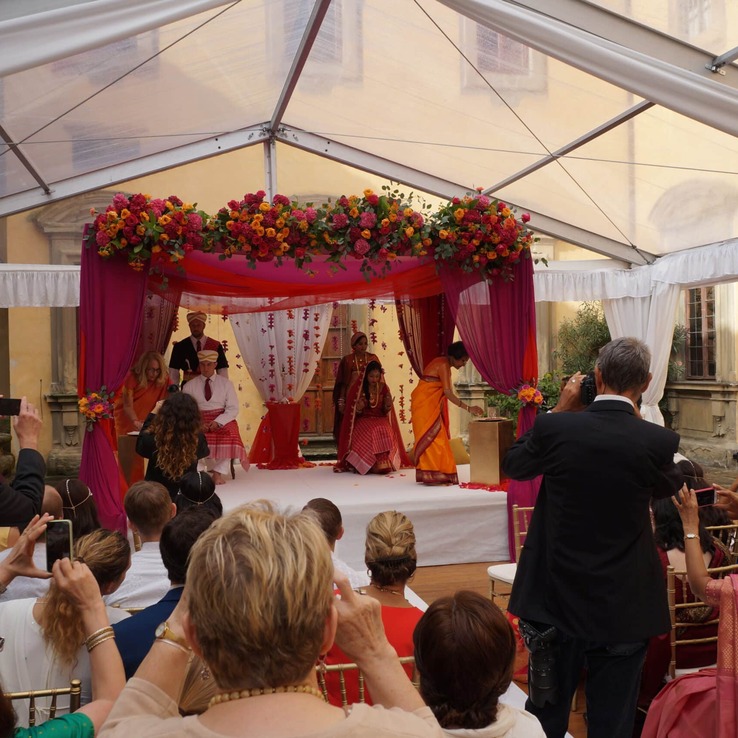
A Hindu Indian wedding in Italy is one of the most established versions of the destination Hindu wedding in Europe. Italy has been hosting these for decades, and the country has developed a level of practical expertise that matters: venues that know what the Maṇḍapa requires, caterers who understand vegetarian Indian menus, photographers experienced with the multi-day program, and a wider hospitality culture that treats extended family ceremony as something familiar rather than exotic.
Italy is also a country with a particular cultural sympathy for the Hindu wedding. The Italians take family, food, ceremony, and the gathering of generations seriously in a way that does not need explaining to anyone. La famiglia is not just an Italian phrase; it is a working principle of how Italian life is organized. The Indian family arriving for a three-day wedding finds itself in a country whose own instincts about family and celebration are already aligned with its own. This is harder to find than people realize.
The Rite
A Hindu wedding is a Saṃskāra, a consecration, by which two people are made into a household. The fire is established and consecrated as the witness. The opening Gaṇeśa worship is offered. The bride’s hand is given by her father and taken by the groom. Offerings are made into the fire. The couple circles the flame; the seven steps are walked; the marriage is sealed with the seventh.
The fire is the irreducible element. A Hindu wedding without a properly established consecrated flame is, in the older tradition’s understanding, not the rite itself. In Italy this is manageable across virtually all serious venues, provided the conversation is held early and in writing. Italian fire-safety law is detailed but workable; the venues that regularly host Indian weddings know exactly what is required and what they require in return. The full doctrinal treatment of the wedding is in the dedicated account of the Vivāha Pūjā.
Italy’s instincts about family and celebration are already aligned with those of the Indian family arriving for a three-day wedding. This is rarer than it sounds.
Choosing Where in Italy
Venice and the Veneto offer a ceremonial geography unlike anywhere else: the canals, the historic palazzi, the small enclosed courtyards that contain the fire well, and the possibility of arriving for the wedding by gondola from the Grand Canal. Venice suits smaller and more intimate weddings, the city’s scale is not built for very large groups, and it carries a sense of theater that no other Italian destination quite matches.
Tuscany, with its vineyards and historic villas, is treated in detail in the dedicated Tuscany guide. The agrarian setting accords particularly well with the rite’s own agrarian origins; for couples drawn to that resonance, Tuscany is the right answer.
Lake Como sits between the Italian foothills of the Alps and the rolling country south of them, with historic villas that have welcomed celebrations for centuries. The lake setting offers a particular elemental drama. The full Como guide is at the dedicated Lake Como page.
Florence and its surrounding estates bring Renaissance grandeur and a deep cultural setting; the city itself and the properties within easy reach of it offer Hindu weddings a setting whose architectural and artistic depth complements rather than competes with the rite. Budget thirty to sixty thousand for venue, fifty to a hundred for full service for around a hundred and fifty guests.
The Amalfi Coast is the most elementally dramatic of Italian options, the sea below, the cliffs behind, the southern sun above. It works best for smaller weddings; the narrow roads and cliff-face venue access do not suit large groups. For an intimate celebration in a setting of real natural drama, Amalfi is exceptional.
Rome, treated in the dedicated guide to the Hindu priest in Rome, offers an old and cosmopolitan capital with venues across the historic city and the surrounding Lazio region.
The figures given here are indicative ranges for early planning and vary considerably by property, season, and guest count; confirm current rates directly with the venue and suppliers.
Getting Your Guests Across Italy
Italy is well served for an international guest list, though the right gateway depends on the region chosen. Milan’s airports serve the north and the lakes; Rome serves the center and the capital; Florence and Pisa serve Tuscany; Naples serves the Amalfi coast and the south; Venice has its own airport for the Veneto. A guest list gathered from several countries usually converges through more than one of these, and the fast train links the major cities within a few hours of one another, so naming the nearest airport clearly on the invitation, and the onward route to the venue, saves a great deal of confusion.
Once in the country, the rural estates of Tuscany, the lake villas, and the cliff venues of Amalfi all sit some way from the nearest airport and reward arranged transfers over leaving each guest to navigate alone, particularly for the evening events. The city weddings, Rome, Florence, Venice, are gentler in this respect, with guests housed near the venue and moving easily on foot or by short transfer. The region’s geography, in other words, shapes not only the look of the wedding but the logistics of gathering everyone, and a venue chosen with the guest journey in mind tends to give the smoothest few days.
The Three Days, Across an Italian Estate
A full Hindu wedding program is typically three events across two or three days: the Haldi or turmeric rite, the Mehndi or henna evening, and the Sangeet, the music gathering. Italian estates suit this beautifully. Gardens for the Mehndi, terraces and ballrooms for the Sangeet, intimate enclosed rooms for the Haldi.
When confirming a property, ask: can it host events across multiple days; are there separate spaces for each; can decoration stay in place between events; what is the property’s catering arrangement, since many Italian venues require their preferred caterer and Hindu wedding catering has its specifics; and what are the rules on evening music and on the fire ceremony. Each of these conversations is shorter to have once than to discover after arrival.
The Italian Legal Step
Italy recognizes only the civil marriage performed before an Italian registrar as legally binding. For non-residents the civil process requires apostilled birth certificates, sworn translations into Italian, both partners’ physical presence in Italy, a statement of no impediment completed at the Comune in person, a sworn translator at the ceremony if neither partner speaks Italian, two witnesses, and a contact window with the Comune that generally falls in the months before the wedding date. Sworn translator availability is genuinely limited in peak summer and should be secured early. These requirements change from time to time and should be confirmed with the relevant Comune or a qualified professional rather than assumed; this is general information and not legal advice.
For most couples the simpler path is to settle the legal marriage at home before travelling, leaving the Italian wedding day as a Hindu rite and a celebration, free of paperwork.
Italian Vegetarian Cooking and the Wedding Feast
A practical note often overlooked. Italian cuisine, in its traditional and regional forms, offers one of the world’s most sophisticated foundations for a vegetarian wedding feast. Fresh pasta, risotto, grilled vegetables, legume-based dishes, artisanal cheeses, exceptional olive oil, the Mediterranean’s abundance of fresh produce. A Hindu wedding banquet on an Italian estate can serve a vegetarian menu of real distinction without strain. Progressive Italian chefs embrace this fully; they understand that vegetarian cooking is not a limitation but an invitation. This is one of the practical reasons Italy works as well as it does for Hindu weddings.
In practice most families bring an Indian caterer for the dishes the celebration calls for and let the estate supply the Italian elements alongside, the two kitchens sitting together more comfortably than one might expect, both being old, seasonal, and built on the produce of the land. The one point to settle early is whether the property requires its own catering partner or permits an outside caterer, since this varies considerably and shapes what is possible; it is best confirmed in writing before the contract is signed.
Season
Italy’s wedding year is generous. April and May are spring perfection across most of the country, mild temperatures, blooming gardens, manageable crowds. June, July, and August are peak, beautiful but warm in central and southern Italy, busy across the country, expensive. September and October are favored by experienced planners, the harvest season in Tuscany, the post-summer elegance everywhere else, settled weather, golden light, gentler pricing. November through March is variable, with some seasonal closures, but the country is at its quietest and cheapest.
Within the chosen season, the Muhūrta is calculated for the specific Italian coordinates of the venue, adjusted for local time, rather than borrowed from an Indian almanac. This is worth confirming with the priest before the day’s schedule is fixed.
Five Questions Before Signing the Venue Contract
Does the venue permit an open contained flame for the Hindu rite, with what vessel and what placement. Can the property host the full multi-day program with separate spaces. What is the catering arrangement, and can it serve a sophisticated vegetarian Indian menu. What is the priest’s qualification and how is the auspicious hour being calculated. Is the legal marriage being settled at home or in Italy. With clarity on these five, almost everything else follows.
The country understands what is being asked. The venues know how to host it. The cuisine receives the menu without complaint. Few European destinations offer this much practical fluency for a Hindu wedding.
saha nāv avatu
saha nau bhunaktu
saha vīryaṃ karavāvahai
“May we be protected together. May we be nourished together. May we work together with great vigor.”
TAITTIRĪYA UPANIṢAD · THE PEACE INVOCATION
The prayer is the peace invocation that opens the Taittirīya Upaniṣad, and it is regularly chanted at the start of the Hindu wedding ceremony. May we be protected together. May we be nourished together. May we work together with great vigor. Three petitions, the whole of marriage in compressed form. The Italian estate that hosts a wedding of this kind, with its long tables, its enduring vineyards, and its old instincts about la famiglia, hears this prayer in a language it would, if it could, understand without translation.
Sources: the Taittirīya Upaniṣad, the marriage-rite texts gathered at Sanskrit Documents, and scholarship on the domestic rites through the Oxford Centre for Hindu Studies.
© 2026 AUSTRIAVIENNAPUJA.COM · SANĀTANA DHARMA IN EUROPE
Preserving authentic Vedic transmission across the European continent