Pandit | The Year in a Family’s Life
Hindu Pandit in France: A Year With the Families I Serve
On the work of a Hindu priest in France, told not as a catalogue of services but as the year unfolds: the births and the names, the houses to bless, the weddings to keep, the festivals to honor, the questions a family brings.
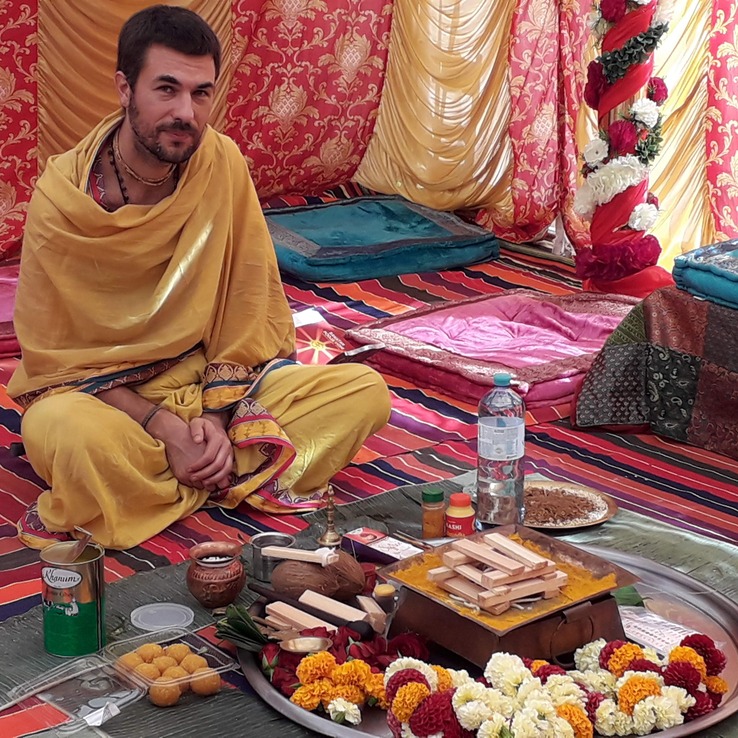
A page on a Hindu Pandit in France can be written two ways. One is the directory: a list of every ceremony available, alphabetical or by life-stage, with a paragraph on each. The other is the way I would rather try here: to say plainly what the work actually is, told the way the year actually unfolds for the families I serve across this country. Both have their place, but the first tends to read like a price-list, and the priest you are looking for is not a vendor of services but a person whose role in your family’s life sits somewhere closer to the family doctor or the trusted teacher, someone the household turns to at the small turnings and the large ones across many years.
So this page is an attempt to describe that: what it is like, what a priest does, why families call on one. It is written for the family in Paris or Lyon who has perhaps never engaged a priest before and is not sure what the relationship even looks like; for the couple in Marseille planning their wedding and wondering what the priest’s role beyond the day itself might be; for the new parents in Toulouse trying to work out what a naming ceremony actually involves. These are the people the page is for, and I hope it gives them an honest picture rather than a marketed one.
What the Word Pandit Means
Begin with the word itself. Pandit, the Sanskrit term, means simply a learned person, one trained in scripture and tradition, but in the context of family life it has come to mean specifically the qualified priest, the Ṛtvij, the one trained to perform the sacred ceremonies that mark the great moments of a household’s life. The training is long: years of memorizing the Sanskrit hymns and learning the precise sequences of the rites, and then years more of apprenticeship and lineage-transmission from a teacher who himself stood in such a line. None of this is glamorous. It produces, at its best, someone who has spent decades quietly preparing to be useful to families at their key moments. The shape of that formation is set out more fully in the account of the Vedic lineage a priest stands within.
The Upaniṣads speak of Dharma as the thing that holds even power itself in check, and a priest’s role is a small share in that holding. What it means in practice is that when an ordinary family wants to keep their wedding properly, or to bless a new home, or to honor an ancestor, or to mark a child’s first solid food, the priest is the one whose training makes the rite possible. He carries the inherited tradition forward, day by day, ceremony by ceremony, so that the household need not lose its connection to it. That is a humble role, but it is what the work actually is.
A priest is not a vendor of services. He is someone the household turns to at its small turnings and its large ones, across many years.
January to March: The Quiet Months
Begin the year in winter. These are the quieter months in the priest’s calendar in France, with less travel between cities and more time for the household ceremonies that happen at home. A new mother in Paris has just had her baby and wishes to keep the naming ceremony at twelve days old, the small, sweet rite in which the child receives the name chosen for them and the parents whisper it into the baby’s ear for the first time. A family in Strasbourg has lost a parent and wishes to keep the memorial offerings at the proper interval. A young couple, recently engaged, want to have their charts looked at quietly before committing further.
These small private rites and quiet conversations are, in many ways, the heart of the work, even though they will never make a wedding photographer’s portfolio. Most of what a priest does in a year is not the great visible ceremony; it is the gentle accompaniment of families through the ordinary turnings, the births, the deaths, the small house-blessings, the questions about a difficult time. February and March move on toward Mahāśivarātri, the great night of Śiva, and the priest sets out for the homes that wish to keep a vigil. The year is starting to lift toward its busier season, but the work in winter has its own particular sweetness.
April to June: Houses and Weddings
Spring brings the rite the French Hindu community asks for more often than almost any other: the blessing of a new home. The auspicious months for a house-blessing fall here, and so do the practical realities of property purchase and moving in. A family in Lyon has just bought their first apartment and wishes to keep the rite before they move their things in; another in Bordeaux has been in their house for years and wants to set right the omission of never having had it blessed. The ceremony itself is simple and tender, the lighting of the first fire in the new kitchen, the offerings in each room, the family’s first meal cooked on that fire afterward, but it changes the household’s relationship to the place in a way they remember for years. The fuller account of that rite is given in the treatment of the Gṛha Praveśa.
Spring and early summer are also the high season for weddings, and most of the families I work with across France have their weddings in these months. Some are kept in Paris or its suburbs, others travel to the south of France or to neighboring countries for the celebration. The wedding day itself is what most people picture when they imagine a priest at work, but the wedding involves many months of preparation before, the chart-matching, the choice of the auspicious time, the conversations about what each rite means and how the day will unfold, all of which the priest is part of. Often it is in these months of preparation, not on the day itself, that the family really comes to know their priest. The fuller account of the wedding rite is set out in the treatment of the Vivāha Pūjā.
July to August: The Summer Pause and the Sacred Thread
High summer is quieter again, with most families on holiday and weddings concentrated in the cooler months either side. But certain rites belong to this season specifically, in particular the sacred-thread ceremony, which the śāstra places in the bright half of the year, spring by preference, and which in the diaspora falls in summer for the plain reason that this is when grandparents can travel. A child of seven or eight in a family near Lyon, his grandparents over from India for the summer, is being initiated into the daily prayer that will accompany him for the rest of his life; another child in Paris is being prepared for the same. There is a poignancy to these ceremonies that the celebrant feels every time: a small child stepping, half-understanding, into a discipline that whole lineages have kept before them.
Summer is also when many families travel to India, and the work shifts a little, more questions by message than ceremonies kept in person, more time to read and prepare and answer the longer queries that arrive about a difficult period in a chart, a question about which ceremony to keep for a sick parent, a request for advice about a child considering an unusual life choice. None of this is dramatic, but it is the texture of the priest’s year, the long quiet conversations that hold the relationship between rites.
September to November: The Festival Season
The autumn brings the great festivals, and these are perhaps the busiest months of all. The nine nights of Navarātri are kept in many French Hindu households, with worship of the Goddess across the nine evenings; the priest travels between homes that have invited him to keep the rites with them. Dīpāvalī, the festival of lights, follows, and with it the special evening worship of Laxmi, the lamps lit in every window, the children’s delight at the brightness. The year is at its peak of devotional life, the houses themselves luminous, the calendar dense with the great observances.
There is something deeply moving about how strongly French Hindu families keep these festivals despite the lack of any institutional support around them. In a country without a temple in most cities, without the public observance that surrounds the same days in India, families nonetheless light the lamps, cook the feasts, gather their children, and call the priest to keep the worship with them. The strength of the diaspora’s quiet faithfulness is, year after year, the most moving part of the work. The fuller account of the rites available to a household is set out in Pūjās and Homas, and the wider arc of life’s ceremonies in the account of the Saṃskāras of the tradition.
December: The Year Closes
December is gentle again, with most families turning toward the secular winter festivities of their European host country and the small private observances that close the Hindu year. A family in Lille might keep a small worship at home to thank the household deities for the year’s protection; another in Nice might quietly turn over the year’s accounts and decide what to put aside for charity in the new one, a small Dharmic discipline the tradition values. The priest’s year too closes, the diary thinning out, time for rest and reading, and the slow planning for the next.
Twelve months, each with its own rhythm of need and observance, of joy and quiet grief, of births to celebrate and parents to mourn and houses to bless and children to launch. This is the substance of the work, told without flourish. If you have come to this page wondering what a Hindu priest in France actually does, the honest answer is this: he tries to make himself useful to the families who call on him, year after year, across the slow turnings of their lives, with whatever the tradition holds out for each turning. Not glamorous, mostly quiet, occasionally beautiful, often very ordinary. The right kind of work.
A Word About Reaching Me
For families in France considering engaging a priest, whether for a single ceremony or for the longer relationship across many years, the simplest path is a first conversation, by message through this site, to talk over what you are looking for and whether the work I do seems the right fit for your family. I travel from Austria across Europe to keep the ceremonies that families request, but the conversation comes first; no one should commit to a priest sight unseen, and no priest worth engaging would ask them to. The wider European context is set out in the account of a Vedic pandit serving Europe.
Whatever you choose, the encouragement is simply this: do not let the absence of a local temple lead you to drop the household observances that the tradition values. The home altar, the daily prayer, the marking of the festivals at home, the rites at the great turnings of a life, these are all keepable in France and in fact have been kept for generations now by the families who came before you. A priest is a help in this; he is not a substitute for the family’s own faithfulness, but he is glad to be of service where his training is needed. That is what the work is, and that is what this page has tried to describe.
Not glamorous, mostly quiet, occasionally beautiful, often very ordinary. The work of a priest in a family’s life across the slow turnings of its years.
tad etat kṣatrasya kṣatraṃ
yad dharmaḥ
“This is the power even of the powerful: Dharma.”
BṚHADĀRAṆYAKA UPANIṢAD 1.4.14
The Upaniṣad’s line has stayed with me as the shortest description of the work I have ever found. Dharma is what holds even power in check, and the priest is not asked to do anything dramatic, only to help hold together, gently and steadily, the long tradition that families across many generations have wanted kept. He is one of many such holders; a teacher of children, a doctor for the sick, a parent at home, all are this in their way. But for the ceremonies the tradition trusts to him, he keeps his small portion of the work, day by day, family by family, year by year, so that what was handed down does not falter in the keeping. That is the role, in France as everywhere, and any family in this country considering engaging a priest is welcome, simply, to be in touch.
The verse cited here is from the Bṛhadāraṇyaka Upaniṣad, with related texts gathered at Sanskrit Documents and scholarship on the role of the priest available through the Oxford Centre for Hindu Studies.
© 2026 AUSTRIAVIENNAPUJA.COM · SANĀTANA DHARMA IN EUROPE
Preserving authentic Vedic transmission across the European continent