Vivāha | Choosing Where in Greece
Hindu Wedding in Greece: Choosing the Place
Greece is not one decision but several. A guide to the choice a couple faces first, island or mainland and which one, and the practical questions that follow it: getting guests and materials to the site, keeping the fire in an exposed setting, the right season, and the legal step.
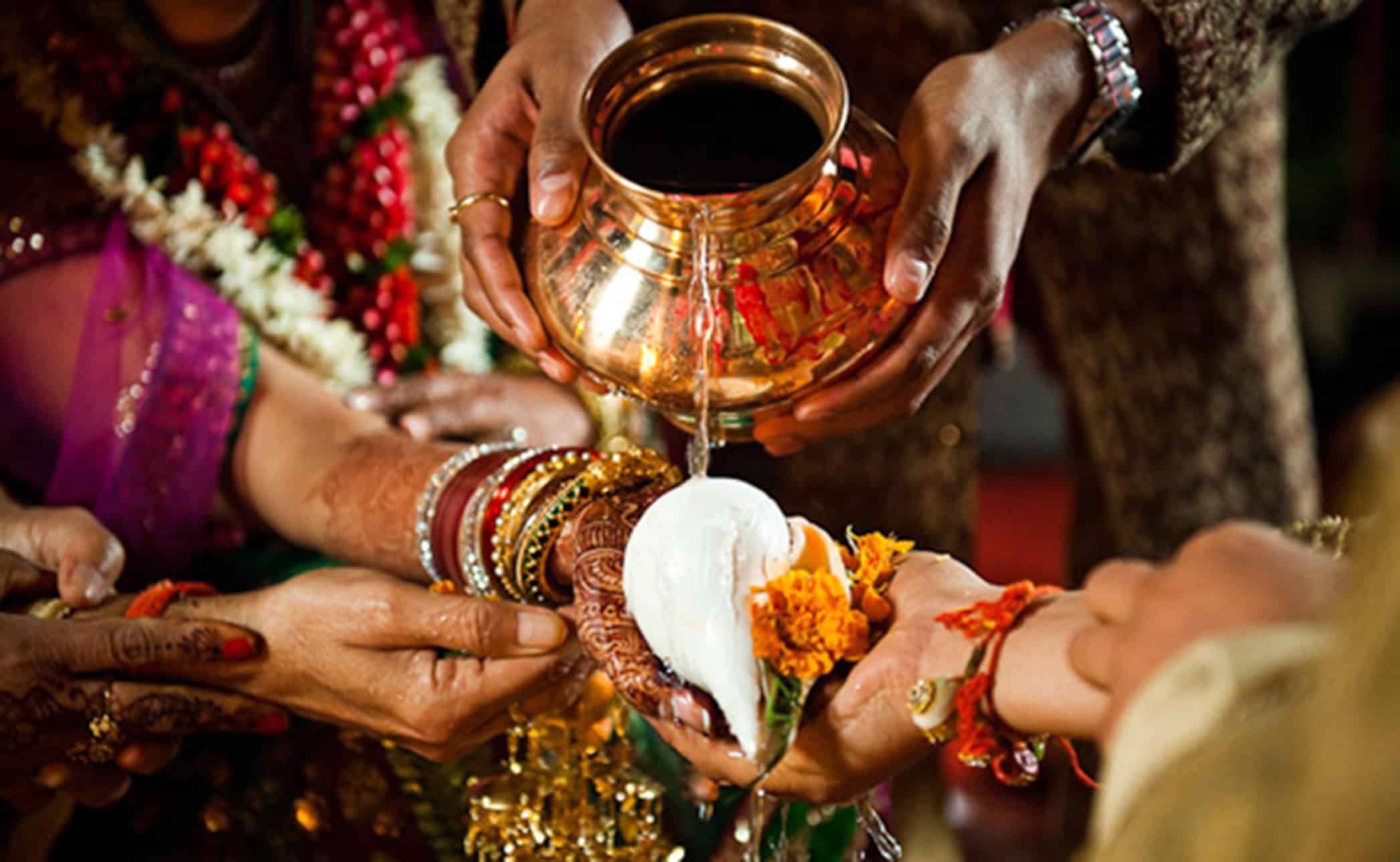
Water poured over joined hands, the gesture by which the giving is sealed.
A couple who decide on a Hindu wedding in Greece have not, in truth, made one decision. They have opened a set of them. Greece is a capital and a long mainland coast and several distinct archipelagos, and the wedding one keeps on a Santorini terrace bears almost no practical resemblance to the one kept at a Cretan resort or in an Athens garden. The rite performed is the same in each; the surround, the cost, and the logistics differ enormously. The first and most useful work a couple can do is to stop treating Greece as a single answer and start choosing, deliberately, which Greece will best hold the gathering they actually have.
One Country, Many Very Different Weddings
The image that draws most couples to Greece is the Cycladic one: white walls, blue domes, a clifftop above a darkening sea. That image is real, and it belongs chiefly to a handful of small islands. But Greece also offers the largest island in the eastern Mediterranean, with the road network and resort capacity to host a celebration of two hundred or more; a capital city with infrastructure, value, and a culture of late dining that suits a long Vedic rite; and a mainland coast within easy reach of an international airport. Each of these is a genuinely different wedding, and the photograph that sold the idea is a poor guide to which one a particular family needs.
The principle that orders the whole choice is simple to state and easy to forget under the pressure of beautiful marketing. The setting is the surround; the rite is the center. The marriage is made by the consecrated fire and the seven steps walked before it, and that is accomplished as fully on one Greek shore as on another. So the setting should be chosen to fit the gathering, the budget, and the comfort of the guests who must travel to it, rather than the gathering forced to fit a setting chosen first for its skyline.
Choose the place to fit the gathering, not the gathering to fit the place. The rite is whole on any Greek shore; the logistics are not equal across them.
Island or Mainland, the First Real Fork
Before any particular venue is considered, one fork decides most of what follows: island or mainland. An island wedding buys the scenery that no mainland venue can quite match, and it pays for that scenery in logistics. Every guest reaches a small island by ferry or by a connecting flight; large venues are few and book far ahead; the fresh materials a rite needs can be harder to source; and costs on the most celebrated islands run well above the mainland for the same standard of celebration. None of this makes an island wrong. It makes an island a choice with a known price, and a couple should enter it knowing the price rather than discovering it after the deposits are paid.
A mainland wedding, by contrast, trades a measure of postcard drama for ease at almost every turn. Athens and its coastal Riviera offer direct international flights, abundant venues accustomed to large international weddings, materially better value, and a city rhythm that dines and celebrates late into the night without complaint. For a large guest list, an elderly relative who cannot manage a ferry, or a budget that must stretch, the mainland is frequently the wiser ground, and a couple loses less of the romance than they fear. The fork is not between beauty and convenience; it is between two kinds of wedding, each beautiful in its own register.
Reading the Greek Options by What the Day Needs
Rather than ranking the Greek settings, it is more useful to read each against the kind of wedding it best holds, because the same island that is perfect for one family is impractical for another.
Santorini, the Iconic Small Wedding
Santorini is unrivalled for the intimate, photograph-led celebration: the caldera, the descending sun, the white terraces that need no decoration. Its venues are mostly small, however, its premium pricing is real, and the late-afternoon wind off the caldera is a genuine factor for a fire ceremony. It suits a smaller party for whom the setting is the point and the budget allows it; it strains a large guest list. The specific work of keeping the rite there is treated in the guide to a Hindu Pandit in Santorini.
Crete, Room for a Large Celebration
Crete is the answer when the guest list is large and the celebration runs across several days. The island is big enough to have a real road network, established resorts experienced with multi-day international weddings, and capacity that the small Cyclades simply lack, generally at better value than Santorini or Mykonos. It trades a little of the iconic skyline for space, comfort, and the ability to host a full Indian wedding at scale. The officiating side of a Cretan celebration is set out in the page for a Hindu Pandit in Crete.
Athens and the Riviera, Value and Late Nights
Athens and the coast south of it offer the easiest logistics, the strongest value, and a culture genuinely at ease with long evening ceremony, alongside venues within sight of the ancient city. It suits the couple who want a substantial celebration without island freight costs, and who value an international airport and abundant accommodation over a clifftop. The fuller treatment of the capital, its venues and its particular character, is in the guide to a Hindu wedding in Athens.
Getting Everyone, and Everything, to the Site
The logistics of a Greek wedding are the part couples most often underestimate, and the island choice multiplies them. Guests must be moved, sometimes by a flight into Athens and a connecting ferry or short hop, and accommodation near a small-island venue is limited and fills early. For a multi-day celebration the movement of the party between events becomes its own piece of planning. These are solvable problems, but they are real work, and they are far lighter on the mainland than on an island reached only by sea.
Less obvious, and more important to the rite, is the movement of the ceremony’s own materials. A competent priest carries the items that cannot be sourced reliably abroad, the threads, the powders, the camphor, and frequently a portable fire vessel, and provides a written list of what must be obtained fresh near the venue, the flowers, the fruit, a coconut, the clarified butter, the water for the sacred vessel. On a small island even these fresh items can be harder to secure, which is another quiet argument for raising the question early with the officiant rather than assuming the local market will provide. The priest’s own travel across the country is part of the same conversation, treated in the page for a Hindu priest in Greece.
The Fire in an Exposed Setting
Greece is a windy country, and the summer meltemi can rise without warning on an exposed terrace or beach. This matters because a Hindu wedding is conducted before Agni, the sacred fire, who in the Vedic understanding is the witness before whom the vows are sworn and the mouth through which the offerings reach the powers invoked. No electric lamp or symbolic flame can take his place; the rite is performed before a witness, and the correctly kindled flame is that witness. The fire is therefore not negotiable, and the wind must be planned around rather than wished away. The meaning of that fire and the offerings made into it is set out in the account of Homa and the Vedic fire.
In practice this means a contained fire vessel placed against the prevailing breeze, a canopy oriented and partly screened so the flame holds, and an officiant who reads the day’s conditions and adjusts. It also means securing, in writing and before the venue is confirmed, the property’s permission for a contained open flame, indoors or out, with attention to ventilation where the offerings produce fragrant smoke. In the dry southern summer the heightened risk of wildfire can make the contained fire a matter to coordinate with local authorities, and in the worst weeks it becomes a real factor in choosing the date. All of this is workable. None of it is automatic, and a site seen by the priest in advance is worth more than any assurance given from afar.
When to Come
The Greek calendar rewards the shoulder seasons. Spring, through April and May, and autumn, across September and October, bring comfortable warmth, thinner crowds, and gentler pricing, along with the long golden evenings for which the country is loved. High summer, July and August, is hot and busy, and for ceremonies it works best in the evening when the heat softens and at coastal venues where a breeze reaches; the islands in these months are at their most crowded and most expensive. The winter months are unpredictable, with some seasonal closures and occasional weather, though they offer the lowest prices to a couple willing to accept the uncertainty. A spring or autumn date, broadly, gives the most for the least strain.
The Legal Marriage
Greece recognizes as legally binding only the civil marriage performed before a Greek registrar. The Vedic rite is the religious and spiritual consecration of the union; on its own it does not produce a marriage that Greece or a couple’s home country will register in law. The civil requirements for non-residents can be involved, frequently touching on apostilled documents, sworn translations, notice periods, and both partners’ presence, and they change from time to time, so the specifics should be confirmed with the relevant municipality or a qualified professional rather than assumed. This is general information and not legal advice.
Most couples find it simplest to complete the legal marriage quietly at home before they travel, which leaves the Greek day free to be the Vedic rite and the celebration, unburdened by paperwork. This is the arrangement most often recommended, because it lets the ceremony abroad be what it is meant to be rather than an appendage to a registry appointment.
A Sensible Order of Decisions
Engage the officiant first, so the rite’s needs shape every later choice. Decide island or mainland next, since that fork governs cost, logistics, and guest comfort more than any other. Then choose the specific venue, confirming in writing both an unobstructed view at your hour and permission for a contained open flame. Fix the season toward spring or autumn where you can. Plan guest travel and accommodation early, especially for an island. Settle the legal marriage at home before you fly. Built in this order, the day holds together; built against it, the day fights you.
The wider comparison of Greece against the continent’s other settings is at Hindu wedding destinations in Europe, and the meaning of the rite that all this arranging serves is treated in the study of the Vivāha Pūjā.
The skyline is the surround. The fire is the center. Choose the Greece that lets the center be kept well, and the surround will take care of itself.
ihaiva staṃ mā vi yauṣṭaṃ
viśvam āyur vyaśnutam
“Stay here together, never be parted; reach the full span of life as one.”
ṚGVEDA 10.85.42 · FROM THE MARRIAGE HYMN
The verse asks for the one thing the whole long undertaking is finally for, that two should stay together for the full span of a life. The island or the city is the ground on which that is asked; it is not what answers it. A couple who choose their Greek setting wisely, for the comfort of those who travel and the proper keeping of the fire rather than the photograph alone, give the asking the firmest ground the day can offer it.
Primary and academic sources: the Pāraskara Gṛhya Sūtra on the marriage rite, the Manusmṛti with the commentary of Medhātithi, the Ṛgvedic marriage hymn preserved at Sanskrit Documents, and the Oxford Centre for Hindu Studies.
© 2026 AUSTRIAVIENNAPUJA.COM · SANĀTANA DHARMA IN EUROPE
Preserving authentic Vedic transmission across the European continent