Vivāha | In a Land of Old Courtyards
Hindu Wedding in Morocco: A Country of Riads and Quiet Care
On keeping a Vedic wedding in Morocco: the beauty of the riad courtyards and the Atlas hills, an honest account of the country’s practicalities, and what makes the choice right or wrong for a given family.
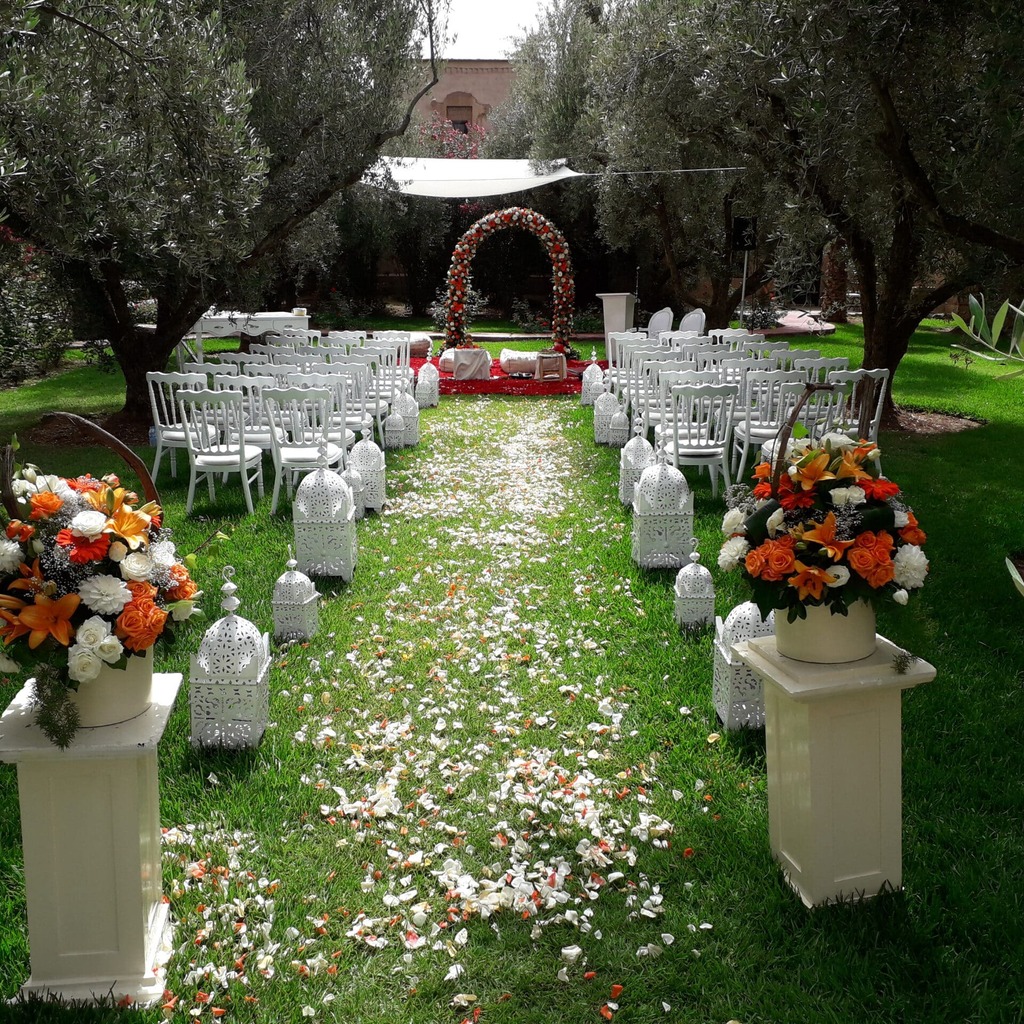
A Hindu wedding conducted in a garden setting in Morocco, the mandap raised for the Vedic rites.
Morocco is among the more striking destinations to which a family might bring a Hindu wedding in Morocco, and I want to be honest about it from the start. The country has real and uncommon gifts to offer such a celebration, the riad architecture with its inward-facing courtyards, the dramatic Atlas Mountains, the warm and unhurried hospitality, the food, the light. It also has practicalities that no marketing brochure should hide. Morocco is a Muslim-majority country, importing certain materials needs planning, and a destination wedding two flights from where most guests live is real work for everyone involved. This page tries to give both sides honestly, so a family considering Morocco can decide with their eyes open.
Families who do choose Morocco and plan carefully come away with celebrations of unusual depth and beauty. The riad, that inward-turning house built around a fountain courtyard, has a kinship with the Vedic Maṇḍapa that few European venues can match, both are old traditions of the held sacred open space, and a wedding kept within one has a quiet rightness to it. The Atlas estates offer mountain settings of the kind no European country can quite provide. The country’s gentleness with elaborate family celebration is genuine. What follows is the honest case for it, with the practicalities the brochure left out.
The Riad and the Maṇḍapa
Begin with what Morocco offers that few other destinations can. The traditional Moroccan house, the riad, is built around an inner courtyard with a central fountain, the rooms opening onto the open court rather than the outside street. It is an architecture of the held sacred enclosure, and to step into a private riad is to enter a contained world whose center is, quite literally, a small square of open sky above a fountain. This is, structurally, the same shape as a Vedic Maṇḍapa, the four-pillared enclosure with the sacred fire at the center, the family gathered around, the sky above. Two old traditions of the courtyard, brought into the same evening.
A wedding kept in a private riad takes on the contained, intimate quality of the building itself. The medina of Marrakech in particular has many such properties available for private hire, often holding the whole wedding party in residence for two or three days, with the ceremony in the central courtyard and the meals and music in the surrounding rooms. The whole celebration unfolds within one held setting, the way a Maṇḍapa-centered rite asks for, and the architectural fit is genuinely uncommon. For families drawn to that depth of setting, no European destination quite offers it.
The riad and the Maṇḍapa are sister architectures: two old traditions of the held sacred courtyard, with a fountain or a fire at the heart.
Marrakech, the Atlas, and the Coast
There are three main regions a family is likely to consider. Marrakech is by far the most established, with the broadest selection of luxury riads, the strongest event infrastructure, and the easiest international flights. A wedding here will lean on the urban riad tradition or, on the city’s outskirts, the larger garden estates that combine riad architecture with grounds enough for a substantial guest list. The medina has the deepest character; the suburbs have the easier logistics; either serves well.
The Atlas Mountains, an hour from Marrakech by car, offer a quite different feel: mountain estates at altitude, cooler in summer, with views of peaks and valleys that no urban setting can match. For weddings in the hot months, June through August, the altitude is a genuine practical gift, the ceremony comfortable when the city would be sweltering. The Atlantic coast, around Essaouira, offers the third option: cooler year-round, breezier, with the simpler whitewashed architecture of a windswept fishing town and the long beaches beyond. Less spectacular than the other two, but lovely in its own quieter way and perhaps the best choice for couples who want sea-air over desert heat.
A Note on the Desert
A practical word about something many destination pages oversell. Morocco’s Sahara, with the great dunes south of the Atlas, is breathtaking and the photographs from a desert ceremony are unforgettable. But the desert is a full day’s drive from Marrakech, the logistics of moving an entire wedding party and the necessary ritual materials there are considerable, the heat in most seasons is severe, and the practical infrastructure, while real, is more limited than in the cities. For most families, the desert is better experienced as an excursion before or after the wedding rather than as the wedding venue itself. A few families have kept the ceremony in a desert luxury camp and remember it with awe, but the cost in coordination and guest endurance is real. Choose with care, and only if both sides of your family will gladly bear the trip.
The Honest Practicalities
Now the honest section every destination wedding page needs and few include. Morocco is a Muslim-majority country, and while the venue industry is professional and welcoming to international ceremonies, a few practical realities follow from this that a family should know. Alcohol service is restricted, available in licensed venues but limited in others, and any wedding planning a substantial drinks component needs to confirm what the chosen venue can provide. Coconut, which is part of many Vedic ceremonies, is straightforward to source. Some other specific ritual materials are best brought with you rather than relied on locally, and a checklist with the priest in advance is worth the half-hour it takes.
The fire ceremony itself is workable in most riads and estate properties with advance coordination, the riad’s open courtyard being ideal in this regard, but it does require the venue to be told well in advance and the priest to work with the property on a safe setting for the Kuṇḍa. Larger venues used to international events handle this routinely; smaller boutique properties may need more conversation. The legal side is the same as for any destination wedding: complete the civil registration at home in your country of residence before traveling, leaving the Moroccan celebration to be the sacred ceremony alone. A purely religious Hindu wedding in Morocco does not carry Moroccan or European legal recognition by itself.
One further practical point concerns the priest. A Vedic wedding in Morocco is almost always conducted by a priest travelling in from Europe, since there is no resident Hindu priesthood in the country, and this needs to be built into the plan rather than left to the last weeks. The priest arrives a day early where possible, to walk the venue, agree the placement of the Kuṇḍa with the property, and confirm that what was promised by correspondence is actually workable in the courtyard as it stands. The lineage and training that stand behind such work are described in the account of the Vedic lineage of a Hindu priest in Austria.
The Hospitality, and the Food
Now to the good side, which is considerable. Moroccan culture’s instinct for hospitality is among the most generous in the Mediterranean world, and the country treats the elaborate multi-day celebration of a family as natural, not exotic. Riads accustomed to wedding hire are practiced at the small attentions, the family delivered in proper comfort to the day, the ceremony held in the right hush, the meals laid generously. The country’s wedding industry is mature; coordinators experienced with Indian ceremonies are findable in Marrakech and the better Atlas estates, and the questions you ask early will mostly meet answers.
The food is a genuine strength, more so than its reputation suggests. Moroccan cuisine has a deeply developed vegetarian tradition, the tagines of root vegetables and pulses, the salads and the cooked vegetable preparations, the breads, the herb-rich kitchen, all of which produce naturally Sāttvika menus without difficulty. A skilled local caterer can put together a wedding feast that blends the Indian dishes the family expects with Moroccan preparations that the guests will remember for years, and the meeting of the two cuisines, both Mediterranean-influenced, vegetable-loving, herb-rich, is unusually happy.
The Seasons
The country has clear windows. March through May and September through November are the most comfortable months across the country, the heat moderate, the light extraordinary, the cities and the countryside at their best. The summer months of June through August bring intense heat to Marrakech and the lowlands, prohibitive for an elaborate outdoor ceremony unless the wedding is kept in the Atlas at altitude, where temperatures stay manageable. Winter, December through February, is mild in the south and milder still on the coast, perfectly viable for an indoor riad ceremony though too cool for a great outdoor celebration.
As with weddings anywhere, the auspicious time is calculated by the priest from the local horizon, the Marrakech sun and sky, not from a distant calendar, and the best day within any chosen season is found that way. The wider geography of destination choices is set out in the account of Hindu wedding destinations in Europe, and the deeper meaning of the rite itself in the treatment of the Vivāha Pūjā.
Whether Morocco Is Right For Your Wedding
An honest summary, since this is the question that matters. Morocco is the right choice for a Hindu wedding when the family is drawn to its particular gifts, the riad architecture, the Atlas landscape, the food, the unhurried hospitality, and is willing to plan with the care a destination two flights from most guests’ homes requires. It is not the right choice when the family is choosing it mainly for the photographs, or when the guest list contains many elderly relatives for whom the journey would be hard, or when the budget is tight enough that the additional logistics costs would strain it.
For the families it suits, it suits beautifully, and they come away with a wedding that will be remembered for its setting as much as for the rite itself. For the families it does not suit, there are other excellent destinations in Europe and beyond that match different priorities. Either choice is honorable; both, made with care, produce a marriage that lasts. The work of choosing is part of the larger work of planning, and worth taking seriously. The priest can help with this conversation as gladly as with the ceremony itself; many families arrive at Morocco, or arrive at Italy, or arrive at home, only after such a conversation.
Morocco’s gift is the courtyard and the unhurried hospitality. Choose it for these, not for the photographs, and you will not regret it.
iha priyaṃ prajayā te samṛdhyatām ।
asmin gṛhe gārhapatyāya jāgṛhi ॥
Here may all you love flourish with your children; keep watch in this house over the household fire.
ṚGVEDA 10.85 · THE VIVĀHA SŪKTA
The verse from the great wedding hymn of the Ṛgveda holds the whole spirit of what this is for. The point is never the place; the point is the founding of the home in which the marriage will be lived. A wedding kept in Morocco is, like a wedding kept anywhere, the beginning of a household, and the country’s particular contribution is to give that beginning a setting of unusual beauty, the riad’s still courtyard, the Atlas’s light, the unhurried meals shared by lamp-light. If those are the gifts your family wants, and if you can plan with the care a destination wedding asks, Morocco will give them gladly, and the memory of the day will last for as long as the marriage it began.
The verse cited here is from the marriage hymn of the Ṛgveda, with related texts gathered at Sanskrit Documents and scholarship on the wedding rite available through the Oxford Centre for Hindu Studies.
© 2026 AUSTRIAVIENNAPUJA.COM · SANĀTANA DHARMA IN EUROPE
Preserving authentic Vedic transmission across the European continent