Vivāha | At the Western Edge of Europe
Hindu Wedding in Portugal: At the Western Edge of Europe
On keeping the Vedic wedding rite in Portugal: the Atlantic cliffs of the Algarve, the terraced hills of the Douro, the seven slopes of Lisbon, and the lovely fact that the same vows are made under any sky.
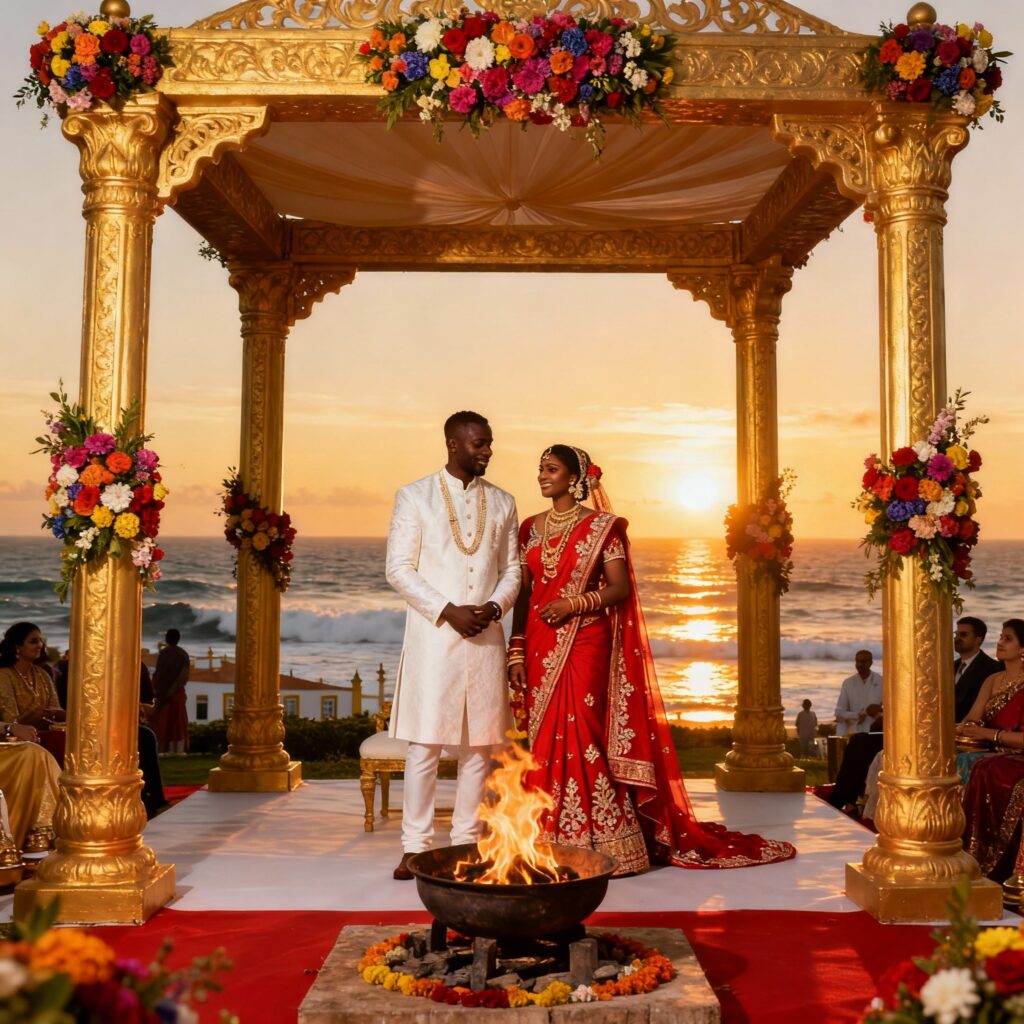
A Hindu wedding in Portugal is a particular delight to plan, because the country meets a sacred ceremony halfway. Portugal is gentle and old and unhurried; its landscapes are dramatic without being theatrical; its hospitality is warm and unfussed; and its three great wedding regions, the Algarve coast, the Douro Valley, and Lisbon, each offer a quite different setting for the same rite. What follows is a practical guide to keeping a Vedic wedding in Portugal, told with affection for the country and respect for the tradition both, with the rites that matter, the regions that suit, the seasons that work, and the honest practicalities a family needs to know.
The first thing worth saying, because it sometimes worries families considering a wedding far from the tradition’s homeland, is that the Vedic ceremony travels whole. Nothing essential of it requires Indian soil. The sacred fire is the same fire under any sky; the seven steps walk the same path on European ground; the Pole Star, gazed upon in the wedding night’s loveliest little rite, shines exactly as faithfully over the Algarve as over Vārāṇasī. So none of what follows is a workaround. A wedding kept properly in Portugal is a wedding kept properly, full stop, and the country offers its own particular gifts to the celebration.
Where the Land Itself Joins In
There is a lovely image in the tradition of the wedding witnessed not only by the family gathered round it but by the great elements themselves, fire and water, earth and air and open sky. None of this is a technical requirement; the rite is complete whatever the surroundings. But there is something to it nonetheless. A ceremony kept indoors against a painted backdrop is complete and beautiful; a ceremony kept where the cliffs fall away to the Atlantic, where the wind carries the smell of the sea, where the open sky stretches without a building in it, has the great elements really there, joining the witness, and Portugal offers this in abundance.
This is one of the country’s quiet gifts to a Vedic wedding: its landscapes are unusually generous in this way. The Atlantic light has a clarity that European interiors cannot manufacture; the cliffs and the terraced hillsides have a weight and antiquity that no decor approaches; the wind from the ocean and the silence of the inland valleys give the ceremony a setting that is simply there, ancient and beautiful, asking nothing of the family but to be received gratefully. Take it as poetry rather than rule, and Portugal becomes a particularly happy choice.
The fire and the sky, the cliffs and the wind from the sea: nothing essential, simply gifts the country gives gladly to a wedding kept upon it.
The Algarve: Cliffs, the Atlantic, the Open Sky
For families who want the wedding under the open sky, with the sea and the cliffs as setting, the Algarve is Portugal’s great gift. Its honey-coloured limestone cliffs run for miles along the southern coast, the Atlantic stretching to the horizon below them, and the clifftop estates of the western Algarve in particular offer terraces and gardens where a ceremony can be kept with the ocean as its backdrop and a vast clear sky above. The southern light is famously generous, and a wedding kept here glows in a way that photographs cannot quite capture; one has to be there.
A practical word on the sacred fire, which is the heart of the rite and not negotiable: most Algarve estates accept an outdoor fire ceremony readily, provided it is kept in a properly contained vessel and the venue is informed in advance. Coastal wind can be a question, easily solved with a sheltered terrace or a simple windbreak. Beachfront ceremonies are wonderful, but during the dry summer months local fire-safety rules can be strict, so an experienced priest and venue together plan the fire’s setting carefully. None of this is daunting; it is the ordinary kind of practical care any wedding in a generous landscape asks for.
The Douro Valley: Old Terraces and a Slow River
In the north of the country, inland from Porto, where the Douro river winds through hills terraced into vineyards by centuries of patient hands, lies one of the loveliest wedding regions in all of Europe. The Douro Valley is older and quieter than the Algarve, the landscape shaped by long human care, and a wedding kept among its hillside estates feels held by the unhurried rhythm of the place. The valley’s quintas, working wine-estates that often welcome small numbers of guests for celebrations, offer something the coast cannot: a contained, self-sufficient setting where the whole wedding party stays and dines and celebrates in one beautiful place, often across two or three days.
For a multi-day wedding, this is a real gift. The family is not shuttling between hotel and venue; the celebrations unfold in one held setting, the morning rites of the wedding day flowing naturally into the ceremony and the evening’s feast without anyone leaving the property. The Douro is also generally easier on the budget than the Algarve at high season, and a Vedic wedding kept among its slow, lovely terraces, by the patient river, has a quality of depth that suits the tradition’s sense of marriage as an unhurried beginning to a long shared life.
Lisbon: A City of Seven Hills
For families who want their wedding in a great city, with the cultural richness and the air-travel ease that come with one, Lisbon is among the loveliest options in Europe. The city is built on seven hills, its oldest neighbourhoods are layered with two thousand years of Roman, Moorish, Christian and modern life, and its character is unfussily warm. The Lisbon hotels and historic venues that host weddings are well used to international ceremonies, including Vedic ones, and a sacred fire kept indoors in a properly equipped room presents no particular difficulty in the better venues, with appropriate ventilation and advance planning.
A Lisbon wedding is the practical choice for many families: airport connections from across the world are excellent, accommodation runs the whole range, and the city itself, with its old quarters and ocean light and remarkable food, is itself part of the celebration for guests who arrive a few days early. For a wedding that wants the deep, cultivated setting of a great European city rather than the openness of the coast or the held quiet of the valley, Lisbon serves beautifully, and with a graciousness that is part of the Portuguese inheritance.
The Pole Star Over Portugal
Among the loveliest of the wedding’s rites, and a particular gift to a marriage kept in Europe, is the showing of the Pole Star on the wedding night. The couple step outside together once the ceremony is over, find that one steady star around which all the others turn, and the groom speaks to his bride the words the Pāraskara Gṛhya Sūtra preserves: firm you are, firm I behold you; be firm with me, O thriving one. Bṛhaspati has given you to me; live with me a hundred autumns. It is a small, tender rite, easily missed, easily kept, and it is a particular joy that the same Pole Star shines above Portugal exactly as it shines anywhere else in the northern world.
The tradition even provides for a clouded sky. If the star cannot be seen, the sūtra says, the bride answers that she sees it notwithstanding, and the rite is kept. An Atlantic night that closes over does not undo it, which is a kindness the old text seems almost to have written for a coastal wedding.
There is something quietly perfect in this for a couple marrying in Europe. The vow they make beneath that star is anchored to the very same point in the sky as has anchored such vows for thousands of years. They can return to it on any clear night for the rest of their lives, in Lisbon or anywhere they later live, look up together at the steady star, and remember the constancy they promised under it. Few wedding rites are so durably portable, or give a couple so beautiful a witness to return to.
Seasons
Portugal has three particularly suited seasons for a Vedic wedding. The spring, especially April and May, offers mild warmth, clear light, and the lovely flowering of almond and orange across the south; pre-summer pricing is gentler at venues, and the days are long enough for an unhurried ceremony. June is also generous, with long evenings and the auspicious twilight hour stretched out for the main rite, before the high summer heat. The early autumn, September into mid-October, is perhaps the country’s most beautiful season: warm seas, golden afternoon light of a quality particular to autumn here, and in the Douro the harvest gathering, which gives the season a quality of completion that suits the founding of a marriage.
High summer, July and August, is hotter and busier, and the great coastal venues are at peak season; weddings are kept here happily, but planning is harder and costs are higher. Winter is gentler than most of Europe but can be wet, and indoor settings come into their own; a Lisbon wedding in a beautiful old room in winter has its own deep loveliness. The auspicious dates within any chosen season are calculated from the local sun and sky by a priest who works from Portugal’s own coordinates, not from a distant calendar, and the right window in any month is found that way. The wider geography of choices across the continent is set out in the account of Hindu wedding destinations in Europe.
A Word on Civil and Sacred
A practical note on the legal side, briefly. The Vedic wedding is the sacred ceremony of the marriage and is what families and the tradition recognise as the marriage itself; the civil registration is the separate matter of legal recognition by the state, and the two are not the same act. Many families coming to Portugal complete their legal registration at home before they travel, leaving the Portuguese ceremony to be purely the religious and family celebration, which is the simpler path. Some do register in Portugal itself, which is possible but takes a few months of paperwork with the local registry, generally handled with a wedding coordinator’s help. These requirements change from time to time and should be confirmed with the relevant authority rather than assumed; this is general information and not legal advice.
The clear, honest thing to say is this: for the marriage to be legally recognised wherever you live, the civil step needs to be done somewhere, and a Vedic ceremony in Portugal does not by itself produce that recognition. Plan for both. Once the legal side is settled, whether at home or in Portugal, the sacred ceremony stands on its own as what the marriage truly is for the couple, the family, and the tradition. The fuller account of what the rite itself means is set out in the treatment of the Vivāha Pūjā.
The Priest’s Part
A word on the role of the priest, who carries the heart of the day. The Vedic wedding is a layered ceremony with many small rites within the larger one, and a priest accustomed to keeping it in Europe brings two things together: the careful knowledge of the rite as the tradition preserves it, and the practical sense of how to keep it gracefully in a European setting, with the sacred fire safely held, the local auspicious time correctly reckoned, and the rites’ meaning translated for the part of the family and the gathered friends who do not yet know it. That last gift matters more than is often realised; when the meaning of each gesture is offered in clear words to the gathering, the ceremony comes alive for everyone present rather than passing as beautiful but opaque.
For families considering Portugal, the wider account of how a European-based priest carries this work across the continent is set out in the page on a Hindu priest in Portugal. There is no need for the choice of region or date to be settled before the details are thought through; many families decide where and how the wedding will be kept in unhurried consideration, and that thinking-through is itself part of preparing for the day.
The Pole Star above Portugal is the same one above Vārāṇasī. The vows made beneath it carry the same weight, anywhere under it.
dhruvam asi dhruvaṃ tvā paśyāmi
dhruvā edhi poṣye mayi
“Firm you are; firm I behold you. Be firm with me, O thriving one.” Spoken by the groom as he shows his bride the Pole Star after sunset on the wedding night.
DHRUVA-DARŚANA · PĀRASKARA GṚHYA SŪTRA 1.8.19
There is something perfect about ending here, with that small night-rite that depends on no venue and no decor, on no Indian soil and no clever logistics, only on a couple stepping outside together when the ceremony is done and looking up at the one steady star. A Hindu wedding in Portugal, planned with care and kept with love, is in the end the same wedding any sincere family keeps anywhere: the fire, the seven steps, the vows truly spoken, and at the close that quiet glance upward at the Pole Star, which has waited in the sky for them, exactly as constant over Lisbon as over any city in the world, ready to witness their promise to each other for as long as either of them shall live.
The understanding of the wedding rite described here rests on the marriage literature of the tradition; the Pole Star vow is preserved at 1.8.19 of the Pāraskara Gṛhya Sūtra, with the texts gathered at Sanskrit Documents and scholarship on the marriage rite available through the Oxford Centre for Hindu Studies.
© 2026 AUSTRIAVIENNAPUJA.COM · SANĀTANA DHARMA IN EUROPE
Preserving authentic Vedic transmission across the European continent