Vivāha | Where Patio Meets Fire
Hindu Wedding in Spain: A Courtyard Country, A Courtyard Rite
On keeping a Vedic celebration on Iberian soil: the natural friendship between the Andalusian patio and the four-pillared Maṇḍapa, three regions that suit a multi-day Hindu marriage best, and the unhurried hospitality of the south.
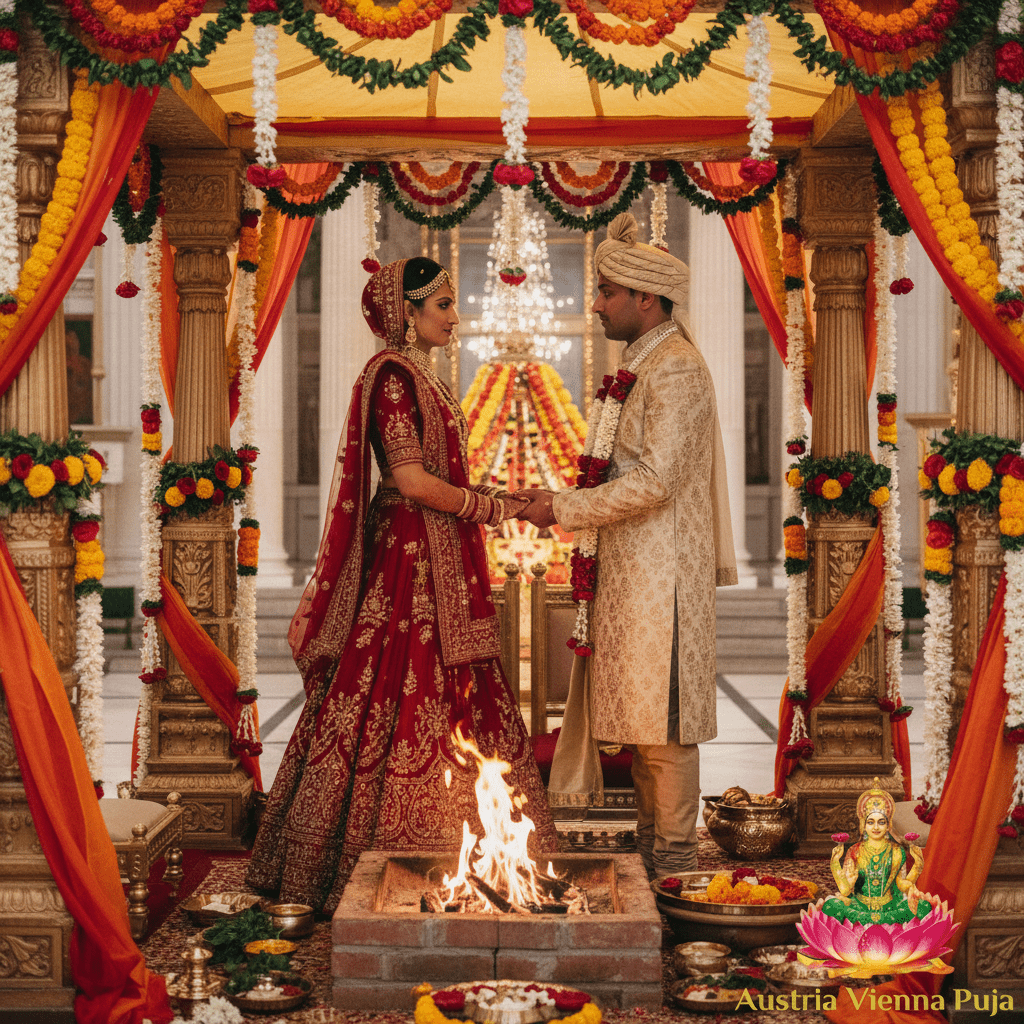
A Hindu wedding in Spain has a quiet, lovely thing going for it that is easily overlooked. The Iberian Peninsula is a place built around the inward-facing open court: from the great Moorish palaces of the south down to the modest patio at the heart of an ordinary southern home, the held open space with a fountain at its centre and the sky above is the region’s signature architectural gesture. The central rite of a Vedic marriage is kept within just such an enclosure, the four-pillared Maṇḍapa with the sacred fire at the centre, those gathered standing round, the sky above. Two traditions, very different in origin, that placed the same shape at the heart of their most sacred ceremonies.
This page is for couples and parents considering the south for a Vedic marriage, and it aims to be plain about what is on offer and what the choice involves. The Iberian setting is genuinely a fine option, with three quite different regions to choose between, a long shoulder-season of beautiful weather, and a hospitality instinct that treats multi-day celebration as normal rather than excessive. It is also, like any destination marriage, more demanding to plan than a marriage at home, and the households who keep them gladly are those who have looked at the trade clearly and judged the place’s particular gifts to be worth it.
Where Two Architectures Meet
It is worth dwelling for a moment on the meeting between the two architectural traditions, because it is uncommon. Most European destinations offer their venues as backdrops, beautiful but unrelated to what happens within them. The south offers something different: spaces conceived from the start as held sacred enclosures, gardens contained by walls, fountains beneath an open sky, decorative geometries that resolve toward a still centre. The Vedic rite proceeds within just such an enclosure, and to set one inside the other is to find them speaking the same language, two careful old traditions of the inward held space, brought together for an evening.
This is not a claim that the theologies behind these forms are the same; they are not. It is simply that the architectural shape each tradition loved, the four walls around an open court, the central feature, the sense of sanctuary within rather than spectacle without, was alike. A Vedic marriage kept inside an Andalusian patio benefits from this kinship in a way no list of amenities can capture: the place itself supports what is taking place there.
Two old traditions of the held open space, the Moorish-Andalusi enclosure and the Vedic Maṇḍapa, meeting for an evening on the same ground.
Andalusia: Granada, Seville, Córdoba
The south, with its three great old cities, is the heart of what has just been described, and for many households it is the obvious choice. Private cortijo estates in the Andalusian countryside, whitewashed walls and orange-tree gardens, offer self-contained settings where two or three days of celebration unfold without anyone needing to change venue. Historic palaces in Seville and Córdoba, when they are available for private hire, place a Vedic rite within architectural beauty of the highest order. Even modest properties carry the patio inheritance down to a small scale. The light in the south is famously generous, the spring warms early, and the long shoulder seasons of April and May, and September and October, are made for outdoor rites.
A practical note on the Seville calendar: the city’s own great religious festivals, Holy Week and the April Fair, fall in spring and effectively close the city to other major events at those times. A Vedic marriage in Seville needs to be planned around them. Granada is gentler in this regard, and the cortijos of its surrounding countryside even more so. Córdoba is quieter still, less touristed than its larger neighbours, and the old centre has a particular grace in early autumn when the worst of the summer heat has passed. Any of the three serves beautifully; the choice is one of feel, and a visit before committing is worth the trip.
Barcelona and the Catalan Coast
North of Andalusia, with a different feel altogether, lies Catalonia. Barcelona is the most cosmopolitan of the Iberian cities, with first-class hotels and venues used to multicultural events, an airport connected across Europe and well served for onward travel from India, and a hinterland of garden estates in the hills above the city and along the coastline. A marriage held in or near Barcelona has a more contemporary character than one further south, less patio, more terrace, more sea, but the practical advantages are real: easier flights for international guests, a wider range of luxury accommodation, and coordinators experienced with Hindu rites.
For households whose priority is logistics, Catalonia is often the wiser pick. The fire is straightforward to arrange in the better venues, the Mediterranean climate offers a generous season from April through October, and the city’s own warmth means guests who arrive a few days early will be well entertained. The hill estates of the Maresme coast and the Penedès wine country, an hour out of the city, give the contained-property advantage of the south closer to a major airport, and many couples find this combination, contained venue plus easy travel, the best balance the region offers.
Coast and Islands: Costa del Sol to the Balearics
A third option for those drawn to the Mediterranean directly: the Costa del Sol, Marbella and the villas above it, and the islands of Mallorca and Ibiza. These are luxury-resort regions, less culturally distinctive than the inland cities but offering high standards of seaside accommodation, a long warm season extending well into autumn, and private estates whose terraces face the open water. A marriage held here trades some of the architectural depth of the historic cities for Mediterranean light and the immediate intimacy of the beach.
For couples whose guests are coming from across Europe and who want a setting that feels like holiday as well as occasion, this can be the best fit. The Balearics in particular, easily reached by direct flight from anywhere in Europe, combine island isolation with full luxury infrastructure, allowing a four-day celebration to unfold within a single property. A fire kept on a private terrace facing the sea, with those gathered around it and the Mediterranean stretching beyond, has its own quiet beauty that no inland setting quite matches.
Hospitality That Suits a Family Rite
A practical word, and an important one for the multi-day character of a Hindu marriage. Everyday culture in the south treats elaborate household celebration as a normal part of life. Long meals are the rule, not the exception; large extended gatherings are familiar to every venue; the unhurried pacing of an Indian day, the early start, the long rite, the late dinner, the music until the small hours, fits the local rhythm with little friction. This sounds like a small thing and is not. Coordinators and caterers who genuinely understand multi-day, extended-household events make the difference between a smooth celebration and an exhausting one.
Catering specifically is a quiet strength. Iberian vegetarian cooking is much stronger than its reputation, legumes, rice dishes, vegetables and herbs of the Mediterranean kitchen, all naturally suited to a Sāttvika menu, and good caterers in any of the three regions can integrate Indian and local dishes into a unified meal that respects both. The same applies to the days of festivity around the main occasion; love of fresh produce, simple grilling, and unhurried meals means the supporting events of a multi-day celebration are well looked after by the local kitchen without elaborate arrangement.
An Honest Word on the Choice
A destination marriage is not right for every household, and a page like this would do its readers no service by pretending otherwise. Holding the day abroad means asking guests to travel and to arrange accommodation, costs that fall on them as well as on the hosts; it means coordinating priest, décor, flowers, and music from a distance; and it usually means doing the legal registration at home before the celebration, since the local civil process is workable but slow for foreign couples. These civil requirements vary and change from time to time, so they should be confirmed with the relevant authority rather than assumed; this is general information and not legal advice. None of it is impossible, but it is real work, and is best taken on by those who genuinely want the place itself and not merely the photographs of it.
For households who do want it, the trade pays. Patio inheritance, long shoulder seasons, the food, the unhurried hospitality, the architectural depth of the south, the easy flights of the north, the seaside of the coast, these are real gifts, and a day kept here with care comes out memorable for everyone present. Fuller context for choosing among European destinations is set out in the account of Hindu wedding destinations in Europe, and the deeper meaning of the rite itself in the treatment of the Vivāha Pūjā.
What Falls to the Priest
The role of the officiating priest in a destination ceremony is larger than at one held at home, because so many of the small adjustments fall to him: working with the chosen venue on a safe setting for the fire, calculating the auspicious time from local sunrise and sunset rather than a distant calendar, walking the household and the guests through the meaning of the rites in clear words so the day comes alive for those who do not know them. A priest used to keeping Vedic celebrations across Europe brings the experience of these small details that make the difference between a stiff event and a deeply felt one. The formation and lineage that stand behind such an officiant are described in the account of the Vedic lineage of the Hindu priest in Austria.
Choice of region and date is rarely settled in isolation. Many households decide where in Spain to hold their day after an unhurried conversation about what they want and what each area offers, and that thinking-through, weighing the patio depth of the south against the travel ease of the north, is itself part of preparing for the occasion. The region rewards the family that considers it carefully rather than the one that books it in haste.
A land built around the held inward space gives a Vedic rite a frame few destinations can. The patio knows where the centre is.
ardhaṃ bhāryā manuṣyasya
bhāryā śreṣṭhatamaḥ sakhā
“The wife is half of the man; the wife is his highest friend.” Spoken by Śakuntalā in the Mahābhārata.
MAHĀBHĀRATA 1.68.40 · ĀDI PARVA
There is a quiet wisdom in the old reflection preserved in the Mahābhārata that touches the heart of what a well-kept day, anywhere, is for. The marriage is not the dress, or the venue, or the photographs, however lovely all of these may be. It is the founding of a small new home, two people who become, from that day, each other’s company, each other’s resting-place, each other’s friend through all that will come. The Iberian setting offers a frame of unusual beauty for that founding, the patio’s stillness, the south’s generous light, but the founding itself is the thing, and it can be made under any sky. The region’s particular gift is to give the day a setting that matches the quiet seriousness of what is actually happening within it: the making of a home that will travel with its two founders wherever they next go.
The reflection cited here is drawn from Śakuntalā’s speech in the Ādi Parva of the Mahābhārata, at 1.68.40; the texts may be consulted at Sanskrit Documents and WisdomLib, with scholarship on the marriage rite available through the Oxford Centre for Hindu Studies.
© 2026 AUSTRIAVIENNAPUJA.COM · SANĀTANA DHARMA IN EUROPE
Preserving authentic Vedic transmission across the European continent