The Domains of Seva
Vedic Rites and Seva by Pandit Sahadev
An overview of the Vedic, Āgamic, and domestic rites conducted for families across Europe: what each is for, when a household needs it, and where the fuller account of each may be found.
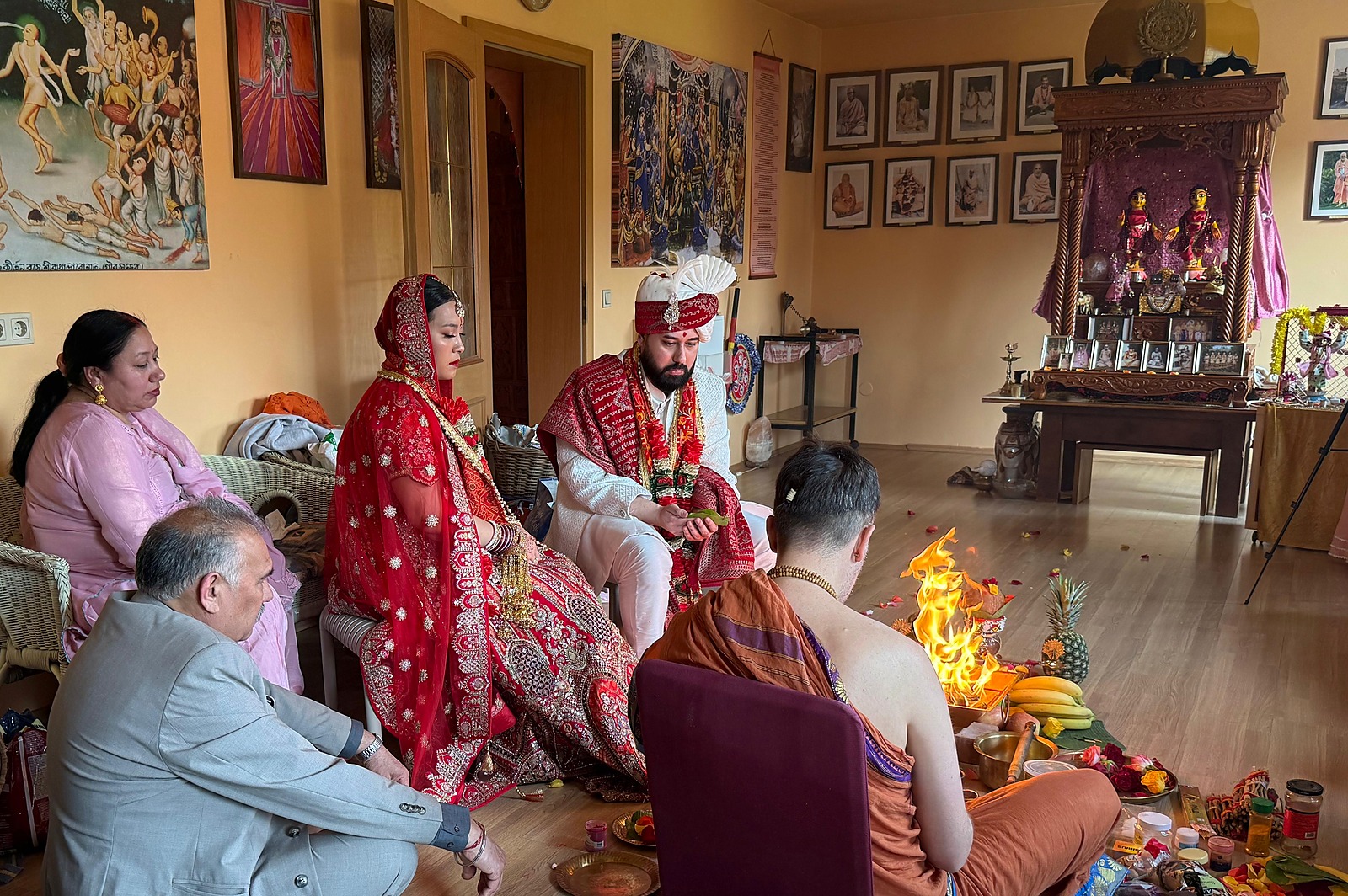
The rites a Vedic priest conducts are not a list of separate offerings but the expressions of a single discipline applied at the different junctures of a family’s life. The Vedic rites set out below, the daily and occasional worship, the fire offerings, the consecrations that mark the passages of a life, the blessing of a home, and the reading of cosmic timing, are conducted for families across Europe on a simple principle: what makes a rite genuine is the qualified hand, the correct Mantra, the properly kindled fire, and the true intention. None of those is bound to any one land.
This page is an overview. Each rite named here opens into its own fuller exposition, where the doctrine, the procedure, and the textual grounding are treated in depth. What follows is the map; the dedicated pages are the territory.
Pūjā: The Worship of the Devatā
Pūjā is the structured worship of a Devatā through the sequence of Upacāras, the offerings of welcome, seat, water, light, fragrance, and food by which the divine presence is invited, honored, and entreated. Conducted in the home or at a consecrated space, it is the most frequent of all the rites, performed at the opening of a new venture, in a season of difficulty, in thanksgiving, and in the steady maintenance of a household’s devotional life. The choice of Devatā and the form of the Pūjā are matched to the occasion and the family’s own tradition rather than drawn from a fixed template.
The doctrine and conduct of worship, together with the principal fire offerings, are set out in the dedicated account of the Pūjās and Homas, and the understanding of worship as the receiving of a guest is treated in the account of Hindu Puja.
Homa: The Offering into Agni
Homa, the offering of oblations into the consecrated fire, is the most characteristically Vedic of all the rites, for Agni is the one who conveys what is offered onward. The Gaṇapati Homa for the removal of obstacles, the Mahāmṛtyuñjaya Homa for health and protection, the Navagraha Homa for the pacification of the planetary influences, and the Lakṣmī Homa for prosperity are among those most often conducted. Each is performed with the complete declaration of intent, the prescribed materials, and the Mantra sequences proper to it.
The metaphysics of the sacred fire and the conduct of the principal fire offerings are examined in the dedicated exposition of Vedic Homa in Europe.
The Saṃskāras: The Consecrations of a Life
The Saṃskāras are the sixteen consecrations through which a person is formed across the whole arc of embodied life: the naming of the newborn, the first feeding of solid food, the first ceremonial cutting of the hair, the sacred-thread initiation that opens formal study, and, at the close, the rites that release the departed and honor the ancestors. Each is conducted at the juncture the tradition appoints, applying the force of the Mantra at the moment when a life is most open to it.
The full architecture of the sixteen is treated in the dedicated study of Saṃskāras and ceremonies of the Hindu tradition, with the childhood rites set out individually in the accounts of the naming ceremony, the first feeding, and the sacred thread.
Vivāha: The Marriage Saṃskāra
The Vivāha is the most elaborate of the domestic rites and the threshold at which a person enters the householder’s station. Conducted before the consecrated fire through the giving of the bride, the taking of the hand, the offering of grain into the flame, and the seven steps that seal the union, it is the rite in which every faculty of the priest’s training is called upon at once. Kept across Europe, it carries the same validity it holds anywhere.
The doctrine and inner structure of the marriage rite are set out in the dedicated exposition of the Vivāha and its architecture.
Gṛha Praveśa: The Consecration of the Home
Gṛha Praveśa is the rite by which an empty dwelling is consecrated as a true household ground, fit for the family’s life and worship. Through the honoring of the presence held to dwell in the ground of any structure, the establishing of the sacred vessel at the threshold, the boiling of milk in the new kitchen, and the seating of the household fire, an inert building becomes a home the family has been received into rather than one they have merely bought.
The conduct and meaning of the entering-of-the-house rite are treated in the dedicated account of the Gṛha Praveśa Pūjā.
Jyotiṣa: The Reading of Cosmic Time
Jyotiṣa, the sixth limb of the Veda, is the discipline through which the auspicious hour is determined for the performance of a rite, and through which the birth chart is read to map the tendencies a person carries across the unfolding periods of a life. The auspicious hour for a rite conducted in Europe is computed for the local horizon, so that the moment is correctly identified for the place where the rite actually occurs rather than borrowed from a distant almanac.
The practice of chart-reading and the doctrinal basis of Vedic astrology are set out in the dedicated account of the Vedic horoscope reading.
Which Rite for Which Occasion
Families new to engaging a priest often know that something should be done but not what. A short orientation may help. When a child is born, the naming follows within the first days or weeks; the first feeding of solid food comes at around six months; the first ceremonial haircut in the early years; and the sacred thread, for families who keep it, in childhood. When two families are to be joined, the marriage rite is preceded by the matching of the charts and the choosing of the hour, both of which want months rather than weeks.
When a household moves, the home is consecrated before the family properly settles into it, and where a house was bought from previous owners the space is first cleared of what came before. When a new undertaking begins, a business, a course of study, a journey, a worship or a fire offering marks the opening. In a season of difficulty, of illness, of obstruction, of a period the chart shows as demanding, a specific fire offering is chosen to answer what is actually happening rather than applied generically. And when someone dies, the last rites are conducted without delay, with the ancestral offerings continuing afterward at their appointed times.
A family uncertain which of these applies does not need to work it out alone. The proper first step is a conversation in which the household describes its situation and the priest says plainly which rite the tradition offers for it, or whether none is needed. A priest who reaches for a ceremony in every circumstance is not serving the family well.
How a Rite Is Arranged
The arranging follows a settled order, and knowing it removes most of the anxiety families carry into a first engagement. It begins with an unhurried conversation about the occasion, the household’s own regional tradition, and what the family hopes the day will be. From that the priest determines which rite is called for and in which form, since the same ceremony is kept somewhat differently by a North Indian household, a South Indian one, a Gujarati or a Bengali family, and a rite shaped to a family’s own line is worth more than a standard one performed identically for everyone.
The hour is then calculated from the local sky, and the date settled around it. A written list follows, dividing what the priest brings from what the household sources fresh nearby, so nothing is left to be guessed at on the morning. Where the rite is kept somewhere other than the home, the venue is asked in advance and in writing about the contained fire, since a live flame is not optional and a property’s willingness to host one is better established early than discovered late. On the day itself the priest arrives well before the guests to lay out the articles and establish the fire, and explains each act aloud as it proceeds, so the family takes part in the rite rather than watching it.
One Discipline, Many Rites
Though they are listed separately, these rites are not separate vocations. They are the single discipline of the officiant applied to the worship of the Devatā, the offering into the fire, the formation of a person across a life, the joining of two lineages, the consecration of a home, and the reading of cosmic time. A family that comes to know its priest across these rites is met by the same trained hand at each, carrying the same precision of Mantra and the same daily discipline to every threshold.
The wider account of this work across the continent is given in the exposition of the Hindu pandit serving Europe, and the training and lineage behind the officiant in the account of the Vedic lineage of the Hindu priest in Austria.
The rites are many; the order they serve is one. To enter any of them with understanding is to enter the whole.
yajñena yajñam ayajanta devāḥ
tāni dharmāṇi prathamāny āsan
“By the rite the gods worshipped the rite; these were the first observances.”
ṚGVEDA 10.90.16 · THE PURUṢA SŪKTA
The closing verse of the Puruṣa Sūkta says something the whole of this page depends on: that the rite is not a human invention laid over the world but among the first things there were, the pattern by which the order itself was established. Whether in the daily worship, the fire of the offering, the consecrations of a life, the joining of a marriage, the hallowing of a home, or the reading of the heavens, the same order is honored and the same tradition carried forward. Each rite is one facet of a single inheritance, and a family that keeps any of them keeps a share in all.
Primary and academic sources: the Pāraskara Gṛhya Sūtra, the classical manual of the domestic rites; the Manusmṛti with the commentary of Medhātithi on the Saṃskāra system and the duties of the officiant; the Vedic corpus at Sanskrit Documents; and peer-reviewed scholarship on Vedic ritual through the Oxford Centre for Hindu Studies.
© 2026 AUSTRIAVIENNAPUJA.COM · SANĀTANA DHARMA IN EUROPE
Preserving authentic Vedic transmission across the European continent