The Family Priest
Hindu Priest in Europe: One Hand for a Lifetime
Why many families settled in Europe come to keep one priest across the years rather than hiring a different officiant for each occasion, what that continuity gives a household from a child’s first rite to the last, and what to look for in the priest you would build that relationship with.
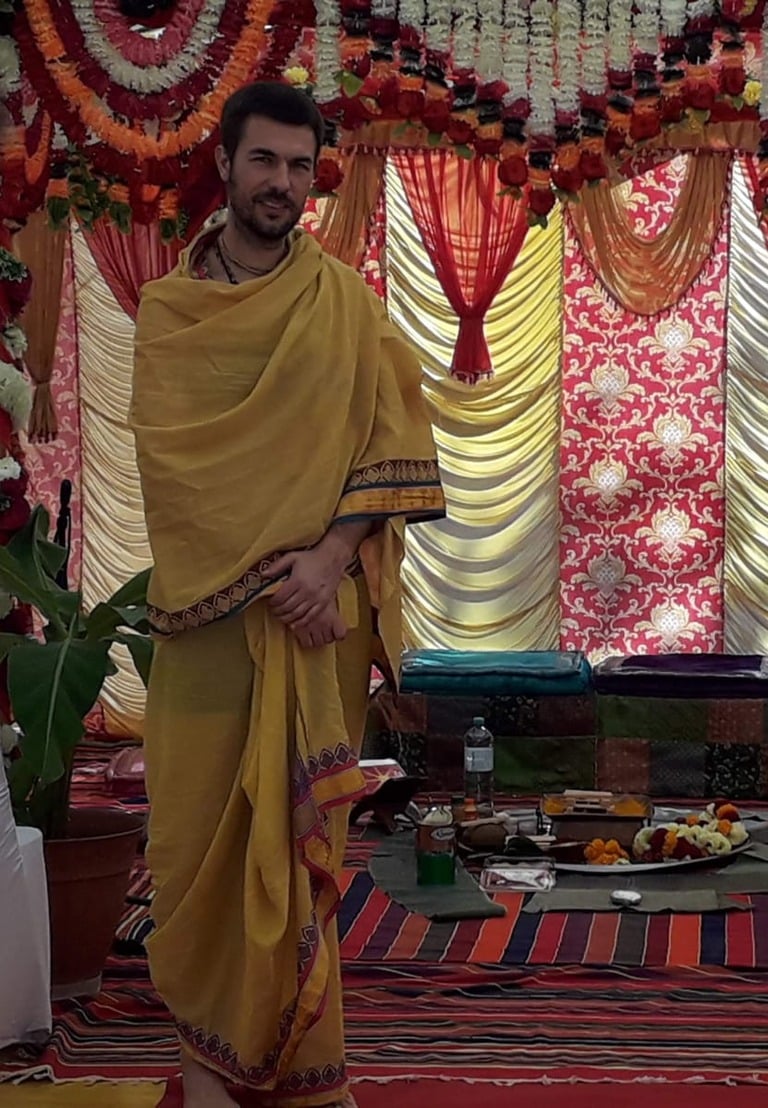
A family rarely calls a Hindu priest in Europe to discuss doctrine. It calls because a threshold has been reached: a child has come and is not yet named, two families are to be joined, an empty flat waits to be made a home, an elder has died and must be released by the proper rite. These are the moments the tradition has always met with a priest, and there is a quiet decision hidden inside each of them that most families make without quite noticing: whether to engage whoever happens to be available this time, or to keep one priest who comes back for the next threshold, and the one after that. This page is about that second path, what it gives a family, and how to choose the person you would walk it with.
Why a Family Keeps One Priest, Not Many
The rites of a Hindu life are easily misread as a catalogue of separate ceremonies, each booked and delivered in isolation, the way one might hire a different caterer for each event. The older understanding is otherwise. The household rites form a single sequence that runs the length of a life, and they are not interchangeable performances but successive chapters of one story, in which the priest is a recurring character rather than a series of strangers. A naming is not really complete on its own; it opens a relationship that the initiation, the marriage, and the later rites continue.
This is why so many settled families come, over time, to keep one priest. The practical gains are real and they compound. A priest who has served a household before already knows its Vedic tradition, its regional customs, the deity the family has long held dear, and the particular way its elders remember the rites being done. He does not have to be briefed afresh each time, and the family does not have to wonder, with each new occasion, whether the person arriving truly knows what he is doing. The continuity is itself part of what makes the rites feel whole rather than assembled.
A priest is not really engaged for a single ceremony. He is received, across the years, into the life of a house.
The First Calls: A Child Arrives
For most families the relationship begins with a child. The Nāmakaraṇa, the naming, performed in the first days after birth, is the first rite many households encounter, and it is more than the announcement of a chosen name; the name is conferred through Mantra at a moment the tradition holds especially receptive, and the rite situates the new child within the larger order it has entered. The small rites that follow in the early years, the first feeding of solid food and the first ceremonial haircut, share the same logic of consecrating the thresholds of a life while the child is young.
Families new to these rites sometimes doubt their weight precisely because they are small in outward scale, a brief ceremony in a living room rather than a grand event. The tradition’s answer is that the earliest formations matter most, and that to mark these first thresholds properly is to begin a child’s life well rather than leave its beginning unmarked. A priest who conducts these first small rites with full care, and who explains them so the young parents understand what is happening, is often the one a family keeps for everything that follows. The full doctrinal account of these and the later rites is set out in the dedicated study of the Saṃskāras and ceremonies of the tradition.
The Great Occasions: Initiation, Marriage, a New Home
As the years pass the rites grow in scale. The sacred-thread initiation, for families who keep it, marks a child’s formal entry into Vedic study and the daily discipline that goes with it, and it turns on the transmission of the Gāyatrī Mantra from teacher to student, one more link in an unbroken descent. The same priest who named the child may be the one to confer it, which is part of what makes the moment land for a family.
The marriage is the most elaborate of all the household rites and the one that asks the most of the officiant at once: he kindles and consecrates the fire before which the vows are sworn, conducts the long sequence of the giving, the taking of the hand, and the offerings, and brings the rite to completion in the seven steps that seal the union. It is the occasion on which the difference between a trained priest and a confident performer shows most clearly, and it is treated in full in the study of the Vivāha Pūjā. The married couple then needs a home made into a household, and the Gṛha Praveśa consecrates an ordinary dwelling into a true family ground with its own sacred fire, a rite that carries particular weight for families establishing themselves in an unfamiliar country, and which is set out in the account of the Gṛha Praveśa.
The Quiet Continuity: The Rites of the Year
Between the rare great occasions runs the steady current of the recurring rites, and it is here, far more than at the grand events, that a priest becomes a familiar presence rather than a stranger summoned in extremity. The festivals turn with the year, each with its own deity and observance, and a household calls for worship and fire offerings at the opening of a new undertaking, in a season of difficulty, in thanksgiving, or simply to keep the home’s devotional life current. Matching the right rite to the moment is itself part of what a knowledgeable priest brings, a matter of judgment rather than selection from a fixed menu.
It is across these smaller, repeated occasions that a priest comes to know a family and a family its priest. He learns their tradition and their inherited customs; they learn that the hand which arrives is the same each time, carrying the same precision and the same care. This unglamorous continuity is where the greater part of the relationship actually lives, and it is what turns an engaged officiant into a family’s own priest. The range of these offerings and the occasions they answer is laid out in the account of the Pūjās and Homas.
When to Call, and How Far Ahead
A practical matter that families often raise only once it has become urgent. The rites differ greatly in how much notice they require, and knowing this in advance spares a household a good deal of anxiety. A marriage wants the longest lead, months rather than weeks, because the auspicious window must be calculated, the venue must agree to a contained fire, and the wider family must travel. A house blessing or a festival observance can usually be arranged within weeks. The rites of childhood fall between the two, since they are tied to the child’s age and to the days the tradition prescribes.
At the other end stand the rites that cannot be planned at all. When a death occurs, the family needs a priest within hours, not days, and this is precisely where an existing relationship proves its worth. A household that already has its priest does not spend the worst day of its year searching for one and explaining its circumstances to a stranger. It makes a single call to someone who already knows the family. Of all the practical arguments for keeping one priest across the years, this is the one families tend to appreciate only afterward.
The Last Rites, and the Circle That Reopens
A life closes as it opened, with a rite, and here a priest’s care matters most. The final rites release the one who has died in the prescribed manner, and they do for the living what grief alone cannot, giving a form to the letting-go rather than leaving a family to face it without knowing how. The bond does not end at the funeral; the tradition holds the living in a continuing obligation to honor the ancestors through the offerings made at the appointed times.
For families settled far from the rivers and sacred places where their forebears kept these rites, the question of how to honor the ancestors from a distant country weighs heavily, and conducting these ancestral offerings properly wherever a family now lives is among the quieter but most valued parts of a priest’s work. Their meaning and conduct are treated in the account of the rites for the ancestors. And here the circle characteristically reopens, for the priest who conducts the last rites for an elder is often the one called, before long, to name that elder’s newest grandchild. The sequence has no real end; it folds back on itself, one generation succeeding another within a single continuous relationship.
mātṛdevo bhava · pitṛdevo bhava
ācāryadevo bhava · atithidevo bhava
“Let the mother be as a god to you, the father as a god, the teacher as a god, the guest as a god.”
TAITTIRĪYA UPANIṢAD 1.11 · THE GRADUATION ADDRESS
The old counsel names the web of sacred relations the household rites exist to honor: the mother and father who gave the first birth, the teacher who gave the second, and the guest who arrives as a form of the divine. A priest moves within this web rather than above it. He comes to a home partly as teacher, the one who clarifies the meaning of the rite, and partly as honored guest, and the family’s care for him and his exactitude in the rite are the single fabric of mutual regard the verse describes. It is a relationship, in the end, not a transaction.
What to Look For When You Engage One
Since this is a relationship you may keep for years, it is worth choosing carefully, and the things that matter most are largely invisible at the moment of the rite. The first is genuine training received in an unbroken line from a teacher who himself learned from a teacher, so that the Mantras are carried as a living transmission; a priest who stands in a real line can name his own teacher and tradition without hesitation. The second is the accuracy of the spoken word, since the rites are carried by their Mantras and the correct sound is the fruit only of long recitation under a living teacher. The third, and least visible of all, is the priest’s own daily discipline kept faithfully, which the tradition holds to bear on the force with which he carries the rites for others.
None of these is easy to verify from a website, which is exactly why the tradition placed such weight on a priest being known within a community rather than merely hired. The visible qualities, a composed manner, fluency, the willingness to explain the rite in a language the family follows, are real and welcome, but they are not the same as the deeper qualification beneath them, and a discerning family learns to ask after it. The training, lineage, and years of service of the priest who serves these families across the continent are set out in the profile of Pandit Sahadev.
Questions Worth Asking First
Ask how the priest was trained and from whom, and whether he can name his teacher and tradition. Ask whether he asks about your family’s own Vedic line and regional customs and adapts the rites to them. Ask whether he will explain each rite in a language your household and guests can follow. And consider, from the start, whether this is someone you would want returning for the next occasion and the one after, because the greatest value of a family priest is the continuity, not the single ceremony.
The rites of a life are not a series of bookings. They are the chapters of one relationship, kept by one hand across the years.
Sources and Further Reading
Pāraskara Gṛhya Sūtra, the classical manual of the domestic rites, from the ceremonies of childhood through marriage to the last offerings (WisdomLib).
Taittirīya Upaniṣad, source of the teaching on honoring mother, father, teacher, and guest, and of the discipline of daily recitation (WisdomLib).
Oxford Centre for Hindu Studies, peer-reviewed scholarship on Vedic ritual, the priestly office, and the rites of families settled abroad.
© 2026 AUSTRIAVIENNAPUJA.COM · SANĀTANA DHARMA IN EUROPE
Preserving authentic Vedic transmission across the European continent