Agni — The Sacred Fire of the Veda
The Vedic Homa in Europe: The Oldest Fire
On the fire offering that stands at the beginning of the Vedic tradition: what it means to give something into the flame, why the sacred fire was called a messenger, and how the rite is carried, unbroken, to a European hearth.
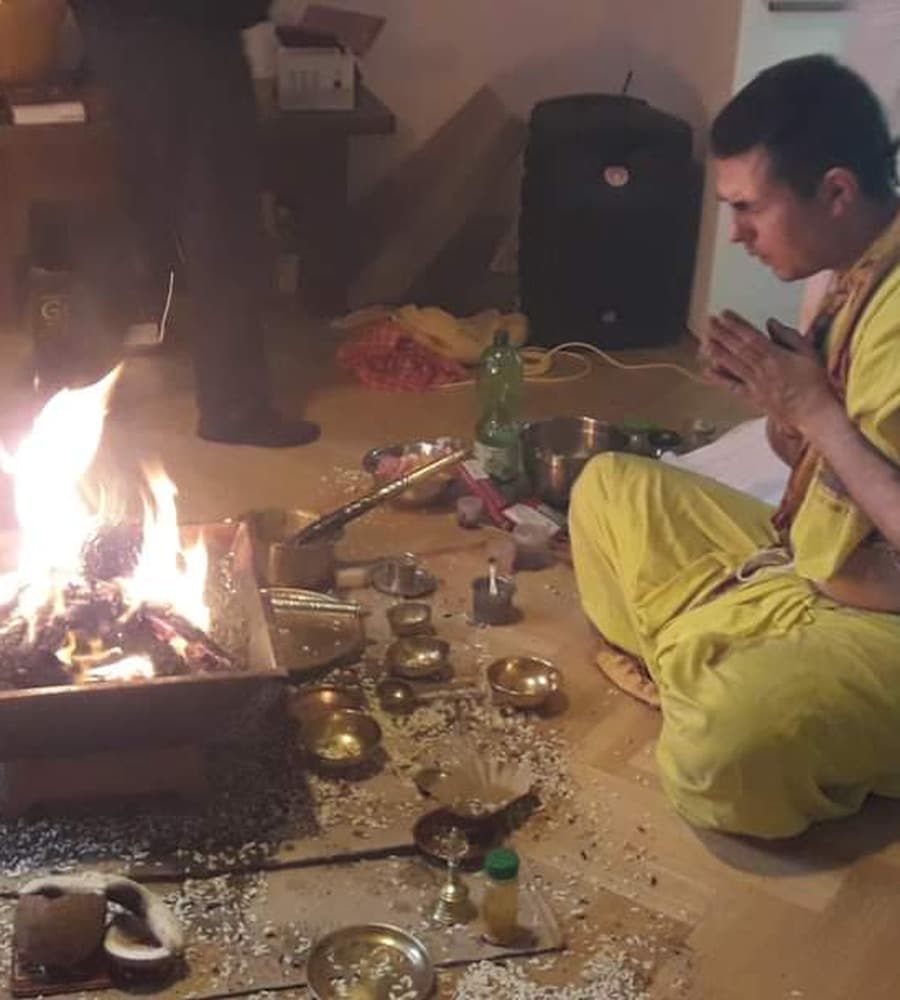
Fire was humanity’s first altar. Long before temples were built or scriptures composed, people gathered at the fire, and something about it, that it gives warmth and light, that it transforms whatever is given to it, that it rises upward as if reaching toward something, made it the natural meeting-point between the human and the sacred. The Vedic Homa ceremony is the most refined and ancient form this instinct ever took: the offering of consecrated substances into a sacred fire, accompanied by the precise words of the Veda. To understand it is to return to one of the oldest religious acts there is, preserved with extraordinary care across thousands of years.
The Homa is easily described from the outside, as offerings placed into a fire while verses are chanted, and just as easily misunderstood by that description, which captures the motions and misses the meaning entirely. What the tradition understands itself to be doing at the fire is something far more considered than burning, and it is worth setting out, because the meaning is the whole of why the rite has endured.
Why the Veda Begins With Fire
It is no accident that the Ṛig Veda, the oldest of the sacred texts and among the oldest compositions in any living tradition, opens with a verse to fire. Its very first word names Agni, the fire, addressed as the one placed in front, the priest of the cosmic order, the one who carries the offering. Of all the powers the Veda might have placed at its threshold, it chose the fire, and that choice tells us how central the fire offering was to the entire world the Veda describes.
In that world, existence itself was understood as a vast and continuous exchange. The cosmos was held together by giving and receiving, by a perpetual offering at every level of reality, and the human fire offering was a participation in that larger movement, a way for a household to take its small part in the great reciprocity by which the tradition believed the world was sustained. To kindle the fire and make an offering was not to perform an isolated ritual; it was to join, knowingly, a cosmic activity already underway. This is the dignity the tradition assigns to even a modest domestic Homa: it is a small enactment of the principle on which it understood everything to rest.
The Logic of Offering
At the heart of the Homa is an act that repays reflection: one gives something into the fire, and the fire consumes it, and nothing comes back in the same form. A measure of clarified butter, grains, fragrant substances, all are given to the flame and not recovered. To the modern eye this can look like waste. To the tradition it is the very meaning of offering, and the contrast is instructive.
An offering is not a transaction. What is given into the fire is given without being kept, and that giving-without-keeping is the act itself, not a means to some other end.
An offering, properly understood, is precisely something given without being kept. The whole gesture turns on relinquishment: one places into the fire what one might have used or consumed, and lets it go. This is what distinguishes an offering from a transaction. A transaction expects an equivalent return; an offering does not. The tradition holds that the giving itself, the willingness to consecrate a portion of one’s substance and release it, is the spiritually significant act, and that something is accomplished in the giver and in the wider order through this relinquishment that could not be accomplished by keeping. The fire is the perfect instrument for this, because it accepts what is given completely and returns nothing in kind, making the offering total in a way few other gestures can be.
The Fire as Messenger, Not Furnace
The tradition is careful about what it believes happens to the offering, and its language is precise. The fire is not understood as a furnace that destroys, but as a messenger that carries. Agni, in the oldest hymns, is the one who bears the offering from the human world toward the powers to whom it is directed, the intermediary between the visible and the unseen. The smoke that rises is imagined not as a by-product but as the visible ascent of the offering toward what receives it.
This is why the Homa is conducted with such attention to the spoken word, and why the fire alone is not enough. Each offering is given with its own sacred formula, naming the power to whom it is directed and the intention with which it is made, and the offering is released into the flame at the word that commits it, the utterance of svāhā that completes each Āhuti. The fire carries; the word directs. Together they make the offering not a mere burning but an address, a thing given to a particular recipient for a particular reason. Strip away the words and one has a fire with substances in it; the words are what make it a Homa.
The Householder’s Daily Fire
It would be a mistake to imagine the Homa as something reserved for grand occasions. In its original form it was woven into the texture of ordinary life. The tradition prescribed for every householder a set of daily offerings, the five great daily acts of giving, of which the offering into the domestic fire was one, alongside the study of sacred texts, the remembrance of ancestors, care for other living beings, and hospitality to fellow humans. The householder was understood to be constituted, in part, by this daily participation in offering; it was not an occasional event but a continuous current meant to run through a home.
The simplest and most ancient of these daily fire offerings was made at the two hinges of the day, dawn and dusk, with small offerings into the kindled fire. The larger and more elaborate Homas that a family arranges for particular occasions are, in essence, the expanded and intensified form of this daily current. Understanding this changes how one sees a commissioned Homa: it is not the importing of something exotic for a special day, but the deepening, at a significant moment, of a practice that the tradition imagined flowing quietly through every Sanātanī household all along. The wider cycle of domestic worship and fire offering is treated together in the dedicated account of the Pūjās and Homas.
What Is Offered, and Why It Is Chosen
The substances offered into the fire are not arbitrary, and the care taken in choosing them is part of the rite’s seriousness. The principal offering is clarified butter, ghee, poured with a ladle and regarded as the foremost of offerings, the bearer of a pure and luminous quality. Alongside it are offered specific woods cut for the purpose, each kind associated with a particular power and function; whole grains, standing for completeness and sustenance; sesame, long linked with the remembrance of the ancestors; and carefully composed mixtures of fragrant herbs whose blend is chosen according to the deity at the centre of the rite.
The rite builds toward a culminating offering, the Pūrṇāhuti, the full and final oblation, in which the remaining offering is given as a single sustained pouring while the closing verse is chanted. There is a fittingness to this shape: the rite does not trail off but completes itself in one whole gesture of giving, the last and most complete of the offerings sealing all that came before. The vessel in which the fire is kindled, too, follows traditional proportions, for the tradition holds that the form of the fire-altar is itself part of the rite rather than incidental to it.
The Principal Fire Offerings
Though all Homas share the same essential structure, particular fire offerings are directed to particular powers for particular purposes, and a few are encountered often enough to name. The Gaṇapati Homa stands first in nearly every case, for Gaṇapati is honored as the one who clears obstacles from the threshold of any undertaking, and his offering opens the way before other rites proceed; it is commonly performed at the start of a new endeavor, the entering of a home, or the beginning of study.
The Mahāmṛtyuñjaya Homa, built on the great verse to Rudra as the compassionate one, is the offering the tradition turns to in times of serious illness or danger and for the welfare and longevity of those one loves; its verse asks, in a famous image, to be released from bondage as gently as a ripe fruit falls from the stem, in the natural fullness of time. The Navagraha Homa addresses the nine governing powers of Vedic astrology, and is performed to bring one’s relationship with them into better balance, often in connection with a difficult period shown in the chart. The Laxmī Homa, drawing on the Vedic hymn to the goddess of abundance, is offered for the grace of a flourishing and rightly ordered prosperity. In each case the tradition understands the Homa as an act of honoring and aligning oneself with the power addressed, undertaken within a life of effort and conduct, rather than as a mechanism that compels a guaranteed result; the offering is sincere petition and participation, not purchase.
Kindling the Fire in Europe
A Homa conducted in Europe is the same rite as one conducted anywhere; the fire, the offerings, the words, and the intention travel with the priest and the family, and none of them belongs to a particular soil. What the European setting asks for is chiefly practical care, and it is care worth taking early rather than discovering on the day.
A Practical Word on the Fire
An open flame indoors is subject to a venue’s safety rules, and many European halls and homes have them. This is never an obstacle to a proper Homa; the fire can be kindled in a suitable portable vessel of traditional proportions and managed to satisfy ventilation and safety requirements without any loss to the rite. Where a substance traditionally used is genuinely unavailable, the tradition itself provides for sensible substitution, holding that what matters is the offering and the intention rather than the precise material exterior. These are ordinary accommodations, long contemplated by the tradition, not compromises of it.
So a family in Vienna or anywhere on the continent need not feel they are receiving a diminished rite. The Homa kindled there is fully the Homa; only the practical arrangements around the fire are adapted to the room it is kindled in.
The fire takes what is given and keeps nothing. In that complete acceptance the tradition saw the perfect image of an offering.
Agnim īḷe purohitaṃ yajñasya devam ṛtvijam
hotāraṃ ratnadhātamam
“I praise Agni, placed in front, the divine priest of the offering, the invoker who bestows the richest treasure.”
ṚGVEDA 1.1.1 — THE OPENING VERSE OF THE VEDA
With this verse the entire recorded tradition begins, and it begins at the fire. That the first words of the oldest scripture are addressed to Agni, the priest placed in front, the carrier of the offering, says more than any argument could about where the fire offering stands in this tradition. It is not one rite among many; it is, in a real sense, the first rite, the act at the threshold of everything else. To kindle a Homa today, even in a hall far from where these words were first sung, is to do again what the tradition did at its very beginning, and to find that the fire answers now as it did then.
The understanding of fire offering described here rests on the Vedic Saṃhitās and the Brāhmaṇa literature on the theology of Yajña; these may be consulted in the Śatapatha Brāhmaṇa and the Vedic texts gathered at Sanskrit Documents, with scholarship on the Vedic ritual tradition available through the Oxford Centre for Hindu Studies.
© 2026 AUSTRIAVIENNAPUJA.COM — SANĀTANA DHARMA IN EUROPE
Preserving authentic Vedic transmission across the European continent