Nāmakaraṇa | The Giving of a Name
Nāmakaraṇa Saṃskāra: The First Gift of a Name
On the Hindu naming ceremony understood as the first gift given to a person: a name chosen with care, whispered before the child can know it, and grown into across a whole life.
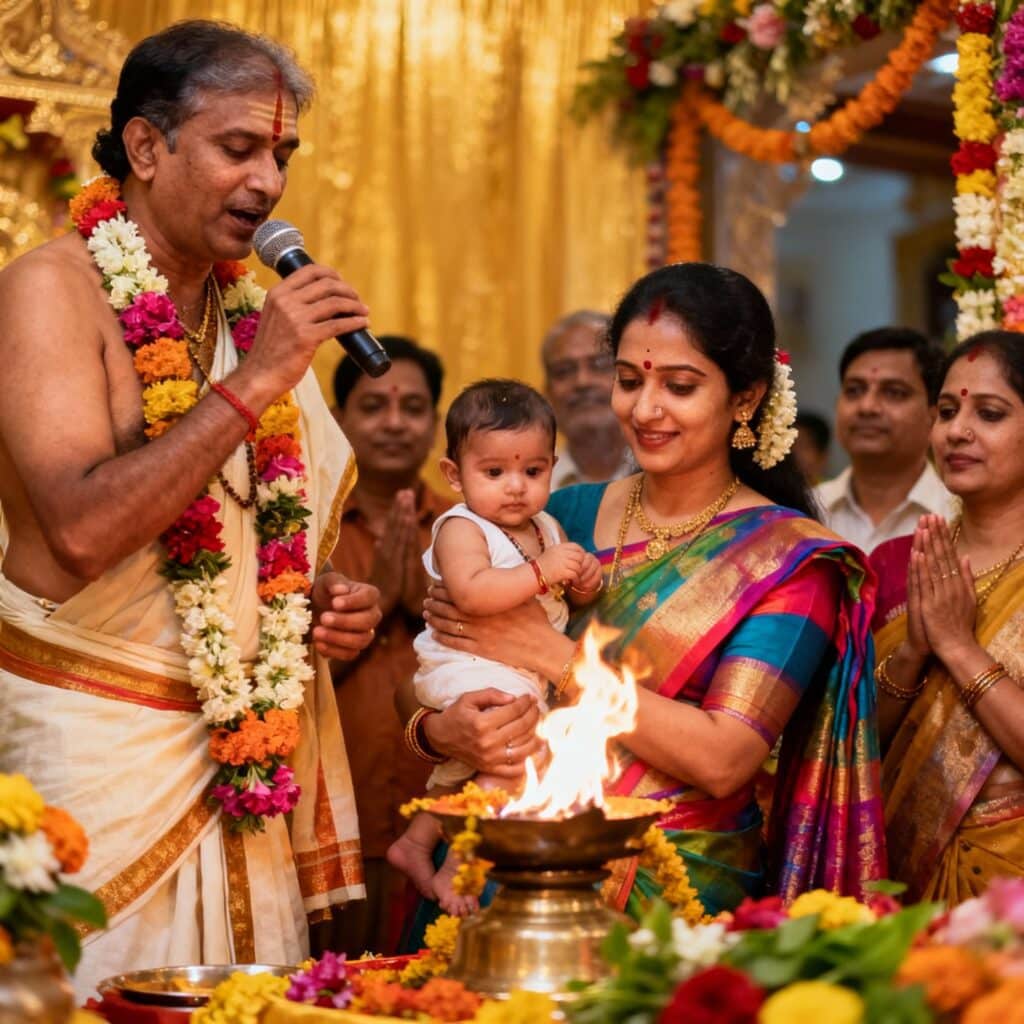
A name is the first thing a person is given that they will keep for life. It is given before the child can ask for it, understand it, or have any say in it, a sound bestowed upon a being who cannot yet know what a sound is, and yet it is a sound that will be spoken over that person more than any other word, until it becomes inseparable from who they are. The Nāmakaraṇa Saṃskāra, the Hindu naming ceremony, is the rite by which this first gift is given, and the tradition surrounds it with great care precisely because it understands how much a name is and how long it lasts.
It is easy to see the naming ceremony as a social occasion, the gathering of family, the announcement of the chosen name, the sweets and the blessings, and it is all of those things. But the tradition holds that beneath the social event lies a quieter and more deliberate act: the giving to a new person of the word they will grow into, chosen not by whim but with attention to the moment of their birth and to the meaning the name will carry. To understand the Nāmakaraṇa is to understand the seriousness with which the tradition gives a first gift.
The First Word a Person Receives
The tradition does not think of a name as a label fastened to a person from outside, the way a tag is fastened to a parcel. It thinks of it as something closer to a seed: a sound given to a child that becomes part of how that child comes to know itself, the word at the center of its sense of being someone. A name, on this understanding, does not merely point to a person who already exists complete; it takes part, in a small but real way, in the forming of that person, because it is the word by which they will be called, and answer, and refer to themselves, every day of their life.
This is why the choosing is done with such care. A first gift of this kind, one that will be carried for a lifetime and never set down, ought to be chosen well, and the tradition’s elaborate attention to the naming, the timing, the sound, the meaning, all follows from taking seriously the weight of what is being given. The name is the first of all the gifts a family gives a child, and the Nāmakaraṇa is the ceremony of giving it rightly.
A name is given before it can be understood, and grown into for a lifetime. The tradition chooses it with the care a first gift deserves.
Why the Tradition Waits
The naming is not done at the moment of birth but after a short interval, traditionally on the tenth or twelfth day, once the period the household keeps after a birth has passed and the home has returned to its ordinary sacred rhythm. Some traditions wait longer, into the child’s third or fourth month, conducting the naming alongside the child’s first formal outing to see the sun. The waiting is not indifference; it is a kind of patience. It allows the newborn to settle into the world a little, and it allows the family to choose the name with deliberation rather than haste.
There is a further reason the tradition values this interval. The naming, when done with full care, draws on the exact moment of the child’s birth, and a short wait allows that moment to be recorded and read properly. The ceremony, when it comes, is therefore not a rushed formality but a considered act, conducted at an auspicious time chosen for the purpose, with the name already thoughtfully selected. The place of this rite within the whole sequence of a Hindu life’s consecrations is set out in the account of the Saṃskāras of the tradition.
A Name Drawn from the Stars
One of the most distinctive features of the Hindu naming tradition is that the first sound of the name is, by custom, drawn from the position of the moon at the child’s birth. The sky is divided, in the Vedic reckoning, into twenty-seven lunar mansions, and each, with its quarters, is associated with particular syllables. The mansion the moon occupied at the moment of birth yields the syllable with which the child’s name auspiciously begins. The reasoning behind this is gentle and rather beautiful: that the first sound of a person’s name should be in tune with the moment they entered the world, so that the name is, from its very first letter, in quiet accord with the sky under which the child was born.
This is not as constraining as it may sound, and it leaves the family a great deal of freedom. The tradition’s care fixes only the opening sound; the choice of the actual name, its meaning, its associations, the family memories or devotions it carries, is left to the parents within that opening. A child whose birth-mansion gives the syllable for a certain sound may receive any of many meaningful names beginning with it, and the family chooses among them according to what they wish to give. The cosmic dimension is honored in the first letter; the human and familial dimension is honored in everything that follows. The two are not in tension, and a good name holds both at once.
The Four Names
Kept in its full form, the Nāmakaraṇa does not give a child one name but four, each drawn from a different source, so that the child is placed at once within the sky, the year, the family’s devotion, and the ordinary life it will live among people. Only the last of the four is heard every day; the other three sit quietly behind it.
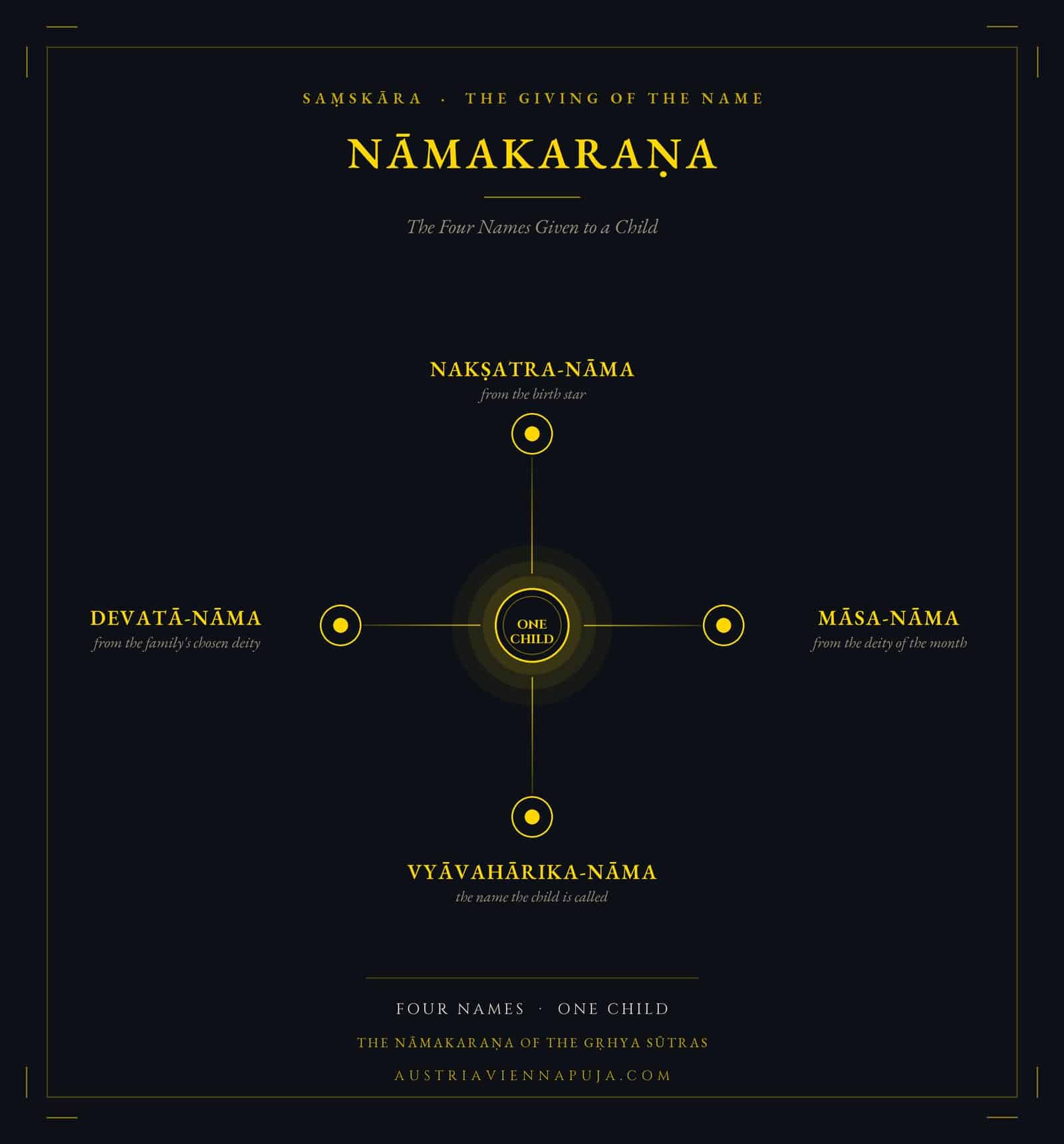
Four names, one child: from the birth star, the month’s deity, the family’s deity, and the name in daily use.
The nakṣatra-nāma is drawn from the lunar mansion the moon occupied at the birth, and it carries the accord with the moment of arrival described above. The māsa-nāma comes from the presiding deity of the lunar month in which the child was born, setting the child within the turning year as well as the sky. The devatā-nāma is taken from the deity the family has long held dear, and it places the child within the household’s own devotion, the line of worship it is being born into. And the vyāvahārika-nāma is the practical name, the one the child will actually be called by parents and friends and teachers, the name that will be written on documents and shouted across a room.
Some families keep a simpler version of this, giving two names rather than four: one for daily use in the world, and one reserved for sacred occasions and known chiefly to the family and the priest. The everyday name takes the wear of ordinary life; the other is kept for the rites, spoken in worship and at the great thresholds, and so kept a little apart and a little protected. Whether four names or two, the principle is the same and worth understanding even where the fuller form is not kept: that a name has both a public life and a sacred one, and that the word by which a person is known in the world and the word by which they are named before the divine need not be quite the same word, worn quite the same way.
The Whisper into the Ear
At the heart of the ceremony is a moment quieter and more tender than the public announcement that people usually picture. The father leans close and whispers the chosen name, softly, into the right ear of the child, three times, while the priest speaks the accompanying words. Only after this private giving is the name spoken aloud to the gathered family. The order matters: the name is first given to the child, intimately, ear to ear, and only then declared to the world. The public announcement acknowledges a gift that has already been made in private.
There is great tenderness in this arrangement, and a deliberate symbolism. The mother holds the child facing east, the direction of the rising sun and of all auspicious beginning, while the father’s voice carries the name in from the side; the child receives its first word held in its mother’s arms and turned toward the dawn. Whatever one makes of the older reasoning about sound and the body, the human meaning of the moment is plain and moving: a family’s first act of speech toward its new member is to give it, gently and by name, its place among them.
What Makes a Good Name
The classical texts give guidance on what makes a fitting name, and read with discernment it remains genuinely useful. A name should carry an auspicious or worthy meaning; it should be well formed and pleasant to say; and it should be a name the person can wear with dignity through a whole life. The older texts also keyed certain kinds of name to the social classes of an earlier age, a scheme that belonged to the world in which those texts were composed; the counsel worth keeping from it, and the part the tradition’s own teachers emphasize, is not that social keying but the enduring principle beneath it, that a name should mean something good and be formed with care.
Within that principle the tradition recognizes several lovely kinds of name. There are names drawn from the divine, such as the names of deities, held especially auspicious because to call the child is, in a small way, to utter the divine name; there are names of virtues, such as discernment, righteousness, or peace, which orient a child toward the quality the family hopes to see grow in them; and there are names built from the birth-mansion’s own syllable, carrying the accord with the moment of birth in their very first sound. A name may belong to more than one of these at once. What the tradition asks is only that the name be chosen as a meaningful gift rather than a passing fashion, for it is, after all, the word the child will carry longest.
Naming a Child in Europe
The naming ceremony is among the easiest of all the rites to keep in Europe, for it asks for very little in the way of place or apparatus: a home, the family’s altar, a small consecrated fire, the right time, and a qualified officiant. The birth certificate of any European hospital records the exact time and place of birth with precision, which is all that is needed to read the child’s birth-mansion and find the syllable from which the name may begin. There is nothing in the rite that the European setting prevents.
A Word for Parents Abroad
The one thing easily lost abroad is the order of choosing. In the tradition the birth-mansion comes first and the name is drawn from it; the ceremony then consecrates that name. Where a name is simply decided in advance and the ceremony merely blesses it, the rite is warm but its proper order is reversed. The remedy is simple: before fixing on a name, ask the officiant to read the child’s birth-mansion and give you the auspicious opening syllable, then choose, freely and lovingly, a meaningful name within it. The conduct of the fire and worship that accompany the rite is described in the account of the Vedic Homa, and the formation of the officiant who conducts it in the account of the Vedic lineage of the Hindu priest in Austria.
So a child born in Europe can be given its name with the full care of the tradition, the opening sound drawn from its own moment of birth, the name chosen with meaning, the word whispered gently into its ear and then spoken to a loving family. The rites that follow in the early years, the first feeding of solid food and the first ceremonial cutting of the hair, continue what the naming begins, and the whole sequence is set out in the broader account of Saṃskāras and ceremonies in the Hindu tradition. Wherever the child is born, the first gift can be given in full.
The name is the first word a family gives a child, and the last spoken over them. The tradition gives it as the gift it is.
aṅgād-aṅgāt sambhavasi hṛdayād adhijāyase
ātmā vai putra nāmāsi sa jīva śaradaḥ śatam
“From every limb you are born; from the heart you arise; you are indeed my own self, named ‘child’; may you live a hundred autumns.”
BṚHADĀRAṆYAKA UPANIṢAD 6.4.8 · THE FATHER’S BLESSING OVER THE NEWBORN
This is among the oldest words a father speaks over a newborn, and it says, in a single breath, everything the naming ceremony means. The child is the parent’s own being come forth, born of the body and arising from the heart; it is given a name, and with the name, a blessing for a long life. The Nāmakaraṇa is the formal and careful giving of that name, but its spirit is here, in this ancient and tender verse: that to name a child is to recognize it as one’s own self come into the world, and to wish it, in the act of naming, every good of the long life ahead.
The understanding described here rests on the domestic-ritual literature of the tradition; the blessing is from the Bṛhadāraṇyaka Upaniṣad, with the Gṛhya texts gathered at Sanskrit Documents and scholarship on the life-cycle rites available through the Oxford Centre for Hindu Studies.
© 2026 AUSTRIAVIENNAPUJA.COM · SANĀTANA DHARMA IN EUROPE
Preserving authentic Vedic transmission across the European continent