Pūjā | The Reception of the Divine
Hindu Puja in Europe | Welcoming the Sacred
On the worship that lies at the heart of daily devotion, understood through the tradition’s own image of it: not a performance before an image, but the receiving of a divine guest into one’s home with the courtesies due an honored visitor.
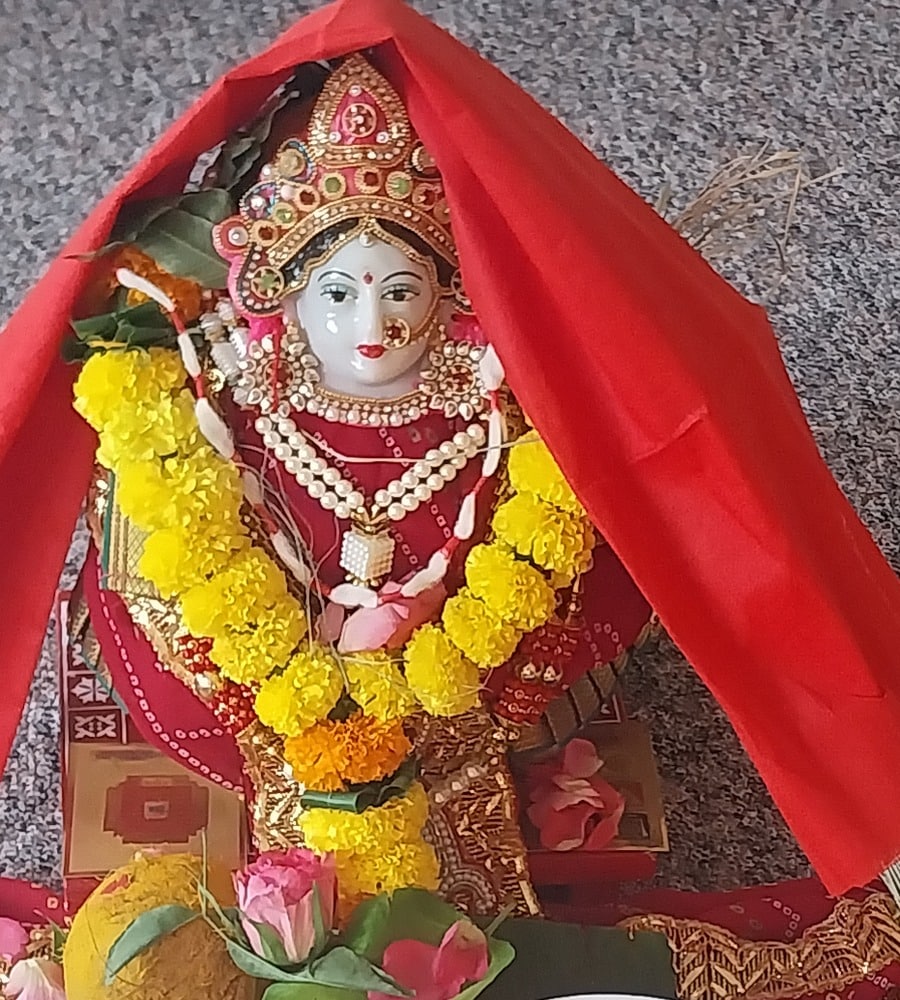
The Devi seated beneath a red canopy, garlanded for a household puja.
There is an old and beautiful way of understanding what happens in a Hindu Puja, and it is the tradition’s own. A Puja is a reception. It is the welcoming of a guest, conducted with the same care, the same sequence of courtesies, that one would extend to the most honored visitor who could enter one’s home. The guest, in this case, is the divine, received into a consecrated focus, and attended to through a series of formal acts of welcome. Once one sees the rite this way, almost everything about it becomes intelligible, for it follows the deep and universal grammar of hospitality.
This is worth dwelling on, because the word worship, as it is usually heard, suggests something rather different: a person expressing reverence toward a distant deity. A Puja is more intimate and more active than that. It is not reverence expressed across a distance but a guest received at close quarters and personally attended to. To grasp the rite, then, one should set aside the picture of worship-at-a-distance and hold instead the picture of a welcome, and let the rite unfold as the welcome it is.
The Oldest Form of Welcome
The tradition holds the welcoming of a guest to be very nearly sacred in itself. An old teaching enjoins that one should treat the guest as one would the divine, and the hospitality offered to a visitor, water to wash with, a seat, food, kind attention, was understood as a genuine spiritual act, not a mere social grace. It is no accident that the worship of the divine took the very same form. The acts offered to a deity in Puja are, almost item for item, the acts a gracious host offers any honored guest who arrives travel-worn at the door.
Seen against this background, Puja is not a strange or foreign practice requiring special explanation. It is the application, to the divine, of courtesies every culture understands. One offers a guest water for their feet and hands after a journey, a comfortable seat, something fragrant and pleasant, food, light against the dark, and one’s respectful attention. The Puja offers exactly these, to a guest understood to be present, and the whole rite is held together by this single coherent gesture of making welcome.
The Guest Who Is Received
Here lies the point most often misunderstood from outside the tradition. The consecrated image, the Mūrti, before which Puja is offered is not regarded by the tradition as a statue standing in for an absent god, in the way a photograph stands in for an absent friend. It is understood, rather, as a place the divine has been invited to be present, made fit through consecration to serve as a true seat of that presence. This is why a Mūrti is formally consecrated before regular worship begins, and why, in the tradition’s understanding, an unconsecrated image and a consecrated one are not the same thing at all.
One need not resolve every metaphysical question to grasp the practical point, which is simply this: the worshipper does not treat the rite as addressed to an absence. The guest is received as genuinely arrived and genuinely present, and the courtesies are offered to someone, not performed before a representation. Whatever one’s own understanding of how the divine relates to a consecrated form, this is the spirit in which the rite is conducted, and it is what gives the welcome its sincerity. A host who believed no guest had truly come would be merely going through motions; the Puja is conducted by one who believes the guest is here.
The image is not a stand-in for an absent god. It is a place the divine has been asked to be present, and is attended to as a guest who has truly arrived.
Two Streams of the Same Welcome
It is worth noting, for the sake of accuracy, that the worship gathered under the single word Puja flows in two distinct streams within the tradition. The older is the Vaidika, the Vedic, centered on the kindled fire and the offering of oblations into Agni with the Mantras of the Saṃhitās, the worship from which the fire rites and the daily Sandhyā descend. The other is the Āgamika, drawn from the Āgamas and the Tantras, centered on the consecrated Mūrti and the temple, in which the divine is invited into an image and attended there. The two are not rivals; most household worship as it is actually kept weaves them together, and the great temple traditions rest chiefly on the Āgamic stream.
The hospitality form of worship described in this account, the sixteen attentions offered to a guest received in an image, belongs principally to the Āgamic stream, and it is the form most families encounter at the home altar and the temple alike. A qualified priest holds both streams: he kindles and feeds the Vedic fire where the rite calls for it, and he conducts the image-worship of the Āgamic tradition where that is what the occasion asks. Knowing which stream a given rite belongs to, and conducting each by its own proper Paddhati, is part of what the training of a priest secures, as described in the account of the Vedic lineage of the Hindu priest in Austria.
The Sixteen Courtesies
The full and traditional form of image-worship is composed of sixteen acts of welcome, the Ṣoḍaśopacāra, the sixteen attentions. Read as a list they can seem an elaborate and arbitrary sequence; read as the hosting of a guest they fall into a natural and even tender order, the order in which one would actually receive a beloved visitor into one’s home.
First the guest is invited in and offered a seat. Then come the courtesies due to one who has travelled: water for the feet, water for the hands, water to sip, the attentions one offers anyone arriving tired from a journey. The guest is then honored more fully, bathed and freshly clothed, adorned, anointed with fragrance. Flowers are offered, and incense, filling the air with sweetness. A lamp is presented, the offering of light. Food is set before the guest, prepared with care. After the meal comes the betel that traditionally closes a hospitable reception, and finally the marks of respect that conclude an audience with someone honored: circling the guest in reverence, bowing before them, and at last the gracious leave-taking when the visit draws to its close.
Every one of the sixteen is an act a thoughtful host would recognize. The rite does not impose an alien sequence; it simply extends to a divine guest the full arc of welcome, from the opening of the door to the farewell, that human warmth has always known how to offer. Each act is accompanied by its own words, naming what is offered and to whom, so that the gesture is not silent but spoken, an attended welcome rather than a mere placing of objects. The fuller cycle of these rites of worship, and the fire offerings that often accompany them, is set out in the dedicated account of the Pūjās and Homas.
Why Devotion Outweighs Splendor
A worry naturally arises from all this talk of sixteen attentions: that proper worship must be elaborate, costly, beyond the reach of an ordinary household, especially one far from where such things are easily arranged. The tradition answers this worry directly and with great tenderness, and its answer is one of the most reassuring teachings in the whole of devotional life.
In a celebrated verse, the divine declares that whoever offers, with devotion, so much as a leaf, a flower, a fruit, or water, that offering is accepted, received from the pure-hearted. The teaching is unmistakable: what is received is the devotion, not the magnificence. A simple offering given with a full heart is welcomed completely, while a lavish one given without sincerity is not. This places true worship within the reach of everyone, the wealthy and the poor, those near the great temples and those in a small flat in a distant city alike. The guest one receives in Puja attends to the spirit of the welcome, not its expense.
This is liberating in practice. A family need not feel that worship offered simply, with what is at hand, is somehow lesser. The grand sixteen-fold form has its place and its beauty, conducted in full on significant occasions; but the daily lamp lit and the flower offered with love at a home altar are not a poor substitute for it. They are, by the tradition’s own word, fully received. The whole weight of worship rests on the heart that offers, and that is something no circumstance can take away.
Prasāda: The Gift That Returns
There is a final movement in the welcome that completes its meaning. The food offered to the divine guest does not stay with the guest; it returns to the household, and it returns transformed. What is given in the offering comes back as Prasāda, a word that means grace or favor, and the tradition understands it to carry now the blessing of the one who received it. The offering given upward returns downward as a gift.
There is a deep courtesy in this, and it mirrors ordinary hospitality once more. A gracious guest does not simply take; something passes back from them to the host, a blessing, a warmth, a gift in return for the welcome. In Puja this return is made tangible: the family partakes of what was offered, now bearing the guest’s grace, and so the rite ends not in depletion but in a shared gift. The welcome offered to the divine becomes, in its completion, a blessing received by the home. This is why Prasāda is treated with such reverence and shared so gladly; it is the visible sign that the guest came, was received, and gave something back.
The Household Altar
For most families, Puja is above all a daily domestic practice, conducted at a home altar rather than only in a temple. The tradition preserves a balanced and time-honored form for this, in which several principal aspects of the divine are honored together at the household shrine, so that a family’s worship is not narrowed to a single form but holds the breadth of the tradition within the home. At the center is placed the form the family holds especially dear, the chosen deity of the household, with the others arranged around it.
What matters most for a home altar is not its grandeur but its regularity and its sincerity. A clean and ordered space, faced in the traditional direction, tended each day with a lit lamp and a simple offering, is the steady heart of a devout household’s life. The consecration of the images by a qualified priest before regular worship begins is the tradition’s way of establishing the altar as a true seat of presence rather than a display; thereafter the daily welcome maintains it. The place of this daily devotion within the wider life of the tradition is treated in the reflection on Sanātana Dharma as a way of life.
Keeping the Welcome in a European Home
A family keeping Puja in Europe is doing nothing diminished by the distance. The welcome offered to the divine is the same welcome wherever the home stands; a guest is received as fully in a European city as on the banks of the Gaṅgā, and the courtesies, the words, and the devotion travel with the family rather than belonging to a particular land. The lamp lit at a home altar in a European city is a true light of welcome, received as such.
A Practical Word
Where a flower, a fruit, or a particular substance customary in worship is hard to obtain, the tradition’s own generosity applies: what is offered with devotion is received, and a sincere offering of what is genuinely available is fully accepted. The teaching of the leaf, the flower, the fruit, and the water was given, in part, for exactly such circumstances. A family need not feel that worship is impossible without the precise materials of another country; the heart of the welcome is the welcome itself, and that can be offered anywhere.
So the European home is not a lesser place of worship. It is simply another doorway at which the divine guest may be received, and the family that keeps the welcome there keeps it in full.
Worship is the art of receiving the divine as one receives a beloved guest: with attention, with warmth, and with the whole of one’s heart.
patraṃ puṣpaṃ phalaṃ toyaṃ yo me bhaktyā prayacchati
tad ahaṃ bhakty-upahṛtam aśnāmi prayatātmanaḥ
“Whoever offers Me, with devotion, a leaf, a flower, a fruit, or water, that offering of devotion, from the pure of heart, I accept.”
BHAGAVAD GĪTĀ 9.26
No verse better captures what Puja is for. It tells the worshipper that the divine guest asks for nothing extravagant, only that what is offered be offered with love. The leaf, the flower, the fruit, the water, the humblest things a home can spare, are received fully when the heart behind them is sincere. This is the whole secret of the welcome, and the reason Puja has remained, for so many centuries and across every circumstance of wealth and poverty and distance, the most intimate and accessible of all the tradition’s rites. The door of every devout home stands open, and the guest, the tradition assures us, comes to whoever opens it in earnest.
The understanding of worship described here rests on the devotional and ritual literature of the tradition; the verse is from the Bhagavad Gītā, with the devotional texts gathered at Sanskrit Documents and scholarship on the devotional traditions available through the Oxford Centre for Hindu Studies.
© 2026 AUSTRIAVIENNAPUJA.COM · SANĀTANA DHARMA IN EUROPE
Preserving authentic Vedic transmission across the European continent