The Anatomy of the Janma Kuṇḍalī
Vedic Horoscope Reading: What It Reveals
What a trained reader actually examines in a birth chart: the frame set by the Lagna, the lords of the twelve Bhāvas, the strength of a placement, the divisional charts, and the sequence of periods through which a chart releases what it holds.
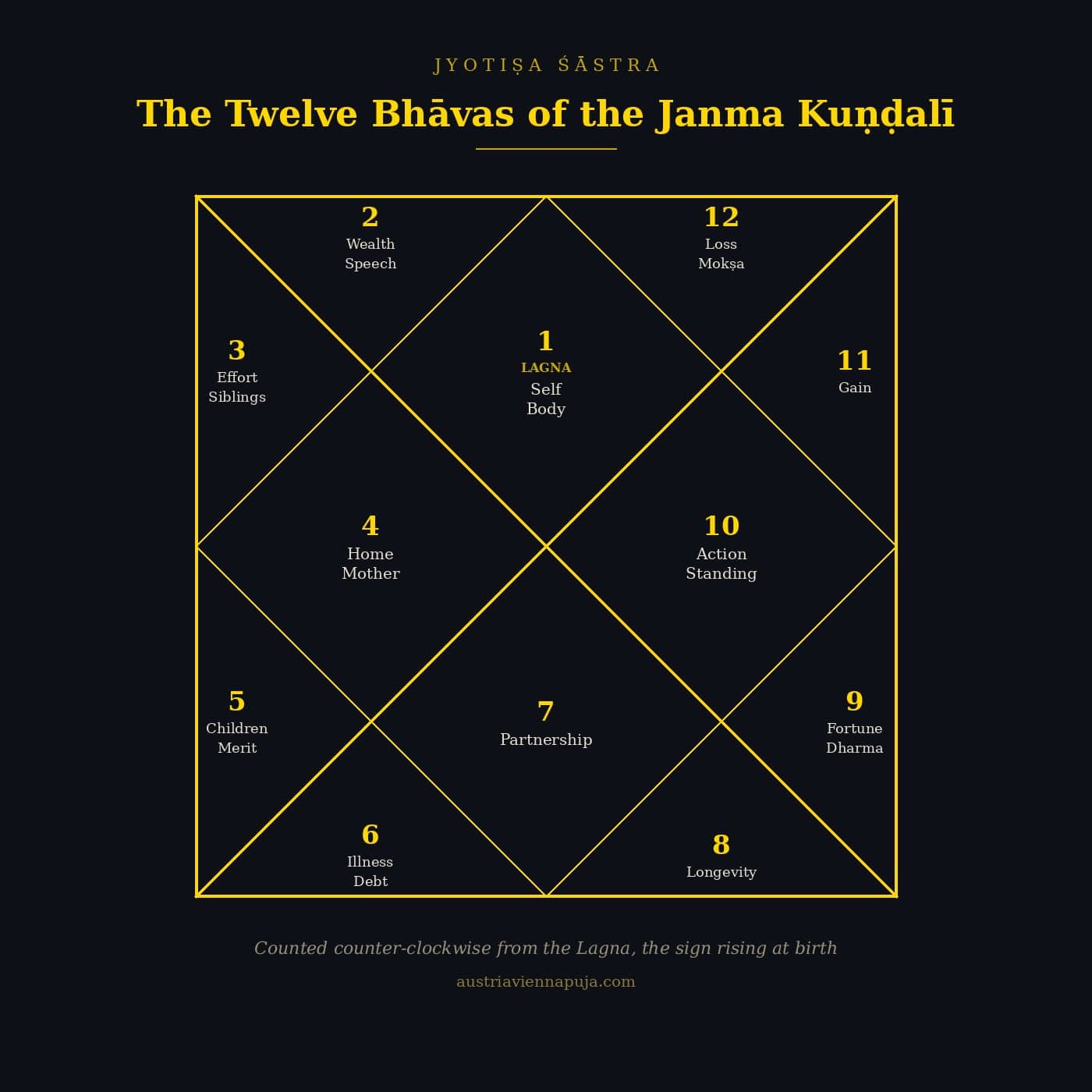
The twelve Bhāvas of the Janma Kuṇḍalī, counted counter-clockwise from the Lagna, each governing its own department of life.
A Vedic horoscope reading is often described in terms of what it can tell a person, and rarely in terms of what the reader is actually doing while it happens. The second is the more useful description, and the more honest one. A chart is not read intuitively. It is worked through in a definite order, by procedures the classical texts set out with some precision, and a person who understands that order can tell the difference between a reading grounded in the tradition and one improvised around a few striking phrases.
What follows is an account of that order: the frame the chart is built on, the significations assigned to its parts, the ways the tradition measures whether a placement is strong or weak, the subsidiary charts that refine the picture, and the sequence of periods by which the whole is released across a life. The doctrinal ground beneath all of it, the question of what a chart is a picture of, is treated separately in the account of Prārabdha and the Vedic consultation, and the discipline as a whole in the account of Vedic astrology in Europe.
The Frame: Lagna and the Twelve Bhāvas
Everything begins with the Lagna, the degree of the zodiac rising on the eastern horizon at the moment of birth. It is not one factor among many. It is the point from which the entire structure is counted, and changing it changes every subsequent judgment. The sign containing the Lagna becomes the first Bhāva or house, and the remaining eleven follow in order around the chart.
The Bhāvas carry the significations by which a chart is read against a life. The first governs the body, constitution, and general disposition; the second wealth, speech, and the family one is born into; the third effort, siblings, and courage; the fourth the mother, the home, and inner contentment; the fifth children, intelligence, and the fruit of prior merit; the sixth illness, debt, and adversaries; the seventh partnership and marriage; the eighth longevity, hidden things, and sudden change; the ninth fortune, the father, and the Dharma one lives by; the tenth action in the world, profession, and standing; the eleventh gain and the fulfillment of aims; the twelfth loss, expenditure, and the withdrawal from worldly activity that includes both sleep and liberation.
Why the Bhāva Lords Matter More Than the Occupants
Popular accounts of astrology dwell on which planet sits in which house, and a trained reader attends to that, but it is not where the weight lies. Each Bhāva is ruled by the Graha that lords the sign upon it, and the condition of that lord governs the affairs of the Bhāva whether or not anything occupies it. An empty seventh house is not a statement about marriage. The condition of the seventh lord is. A house may stand empty and flourish because its lord is well placed, or hold two planets and struggle because its lord is afflicted elsewhere.
This is the point at which most self-taught reading goes wrong, and it is worth stating plainly because it explains why two people can look at the same chart and reach opposite conclusions. Reading occupancy alone gives a chart of isolated fragments. Reading the lords gives a chart of relationships, in which the affairs of one area of life are seen to depend on the condition of a Graha operating in another. The tradition’s judgments about a chart are largely judgments about those dependencies.
The Grahas as Kārakas: What Each Signifies
Alongside the houses, each Graha carries its own permanent significations, its Kāraka role, which it brings to any chart regardless of placement. Sūrya signifies the self, the father, authority, and vitality. Candra signifies the mind in its feeling and receptive aspect, and the mother. Maṅgala signifies energy, initiative, conflict, and the capacity to act decisively. Budha signifies intellect, discrimination, speech, and commerce. Bṛhaspati signifies wisdom, teachers, expansion, children, and Dharma. Śukra signifies refinement, pleasure, the arts, and the marriage partner. Śani signifies time itself, endurance, limitation, labor, and the slow discipline of consequence.
Rāhu and Ketu, the two points where the Moon’s path crosses the Sun’s, carry no rulership over signs in the classical scheme but are read for their profound effect on whatever they touch: Rāhu for amplification, foreign influence, and unregulated appetite; Ketu for withdrawal, dissatisfaction with the worldly, and the residue of prior discipline. A reader considers both what a house means and what its Kāraka says, and where the two disagree, the disagreement is itself information.
Functional Benefics and Malefics
The tradition also holds that a Graha’s effect is not fixed but depends on which houses it rules in the particular chart. A planet that lords a favorable house behaves favorably in that chart even if it is counted a natural malefic; one that lords a difficult house can obstruct even if it is a natural benefic. Śani, generally feared, becomes a strong and steadying influence in charts where it lords the fortunate houses. Bṛhaspati, generally welcomed, can complicate matters where its rulerships fall badly. This is why a competent reading resists the shorthand by which a planet is simply good or bad, and why alarm at hearing a particular name in one’s chart is usually premature.
Strength: How a Placement Is Weighed
Having established what a Graha signifies and what it rules, the reader must judge how capable it is of delivering. The tradition has developed several measures for this. The simplest is dignity: a Graha in its own sign or its sign of exaltation acts with full capacity; in its sign of debilitation it struggles; in the sign of a friend or enemy it is correspondingly assisted or hindered.
Beyond dignity, the texts set out the system of Ṣaḍbala, sixfold strength, which weighs a placement by its position in the zodiac, its direction from the Lagna, its position in the daily and annual cycles, its motion, its associations, and its aspects. The calculation is laborious and rarely computed in full in ordinary practice, but the principle behind it governs all serious reading: that the same planet in the same house can be decisive in one chart and negligible in another, and that saying what a placement means is worthless without saying how strongly it can act.
The Vargas: Divisional Charts and Their Use
One feature distinguishes Vedic reading sharply from other systems, and it is the one most often omitted in casual practice. Beyond the birth chart itself, the tradition constructs a series of Varga or divisional charts, each made by dividing every sign into a set number of parts and mapping those parts onto a fresh chart. Each Varga is then read for a specific department of life.
The most used is the Navāṃśa, the ninefold division, read for marriage and for the underlying strength of the whole chart; a Graha weak in the birth chart but strong in the Navāṃśa is understood to deliver more than its surface position suggests. The Daśāṃśa, the tenfold division, is read for profession and action in the world. The Saptāṃśa is read for children, the Caturthāṃśa for property and fixed assets, and so through a scheme that in its full extent runs to sixteen divisions. A reading that consults only the birth chart is working with a fraction of what the tradition provides, and where the birth chart and the relevant Varga disagree, the tradition weighs both rather than dismissing either. Where two charts are being examined together for a marriage, the Navāṃśa carries particular weight, as the account of chart matching for Hindu marriages sets out.
Daśā and Antardaśā: The Reading of Sequence
All of the foregoing describes a static picture. What converts it into a reading of a life is the system of periods. In the Viṃśottarī scheme, the one most generally used, the whole span is divided among the nine Grahas in a fixed sequence and in fixed proportions, and the point at which a person enters that sequence is determined by the Nakṣatra the Moon occupied at birth. From that starting point the order and the durations are fixed for life. The twenty seven mansions and the derivation of that starting point are treated in the account of the birth chart reading and the Janma Nakṣatra.
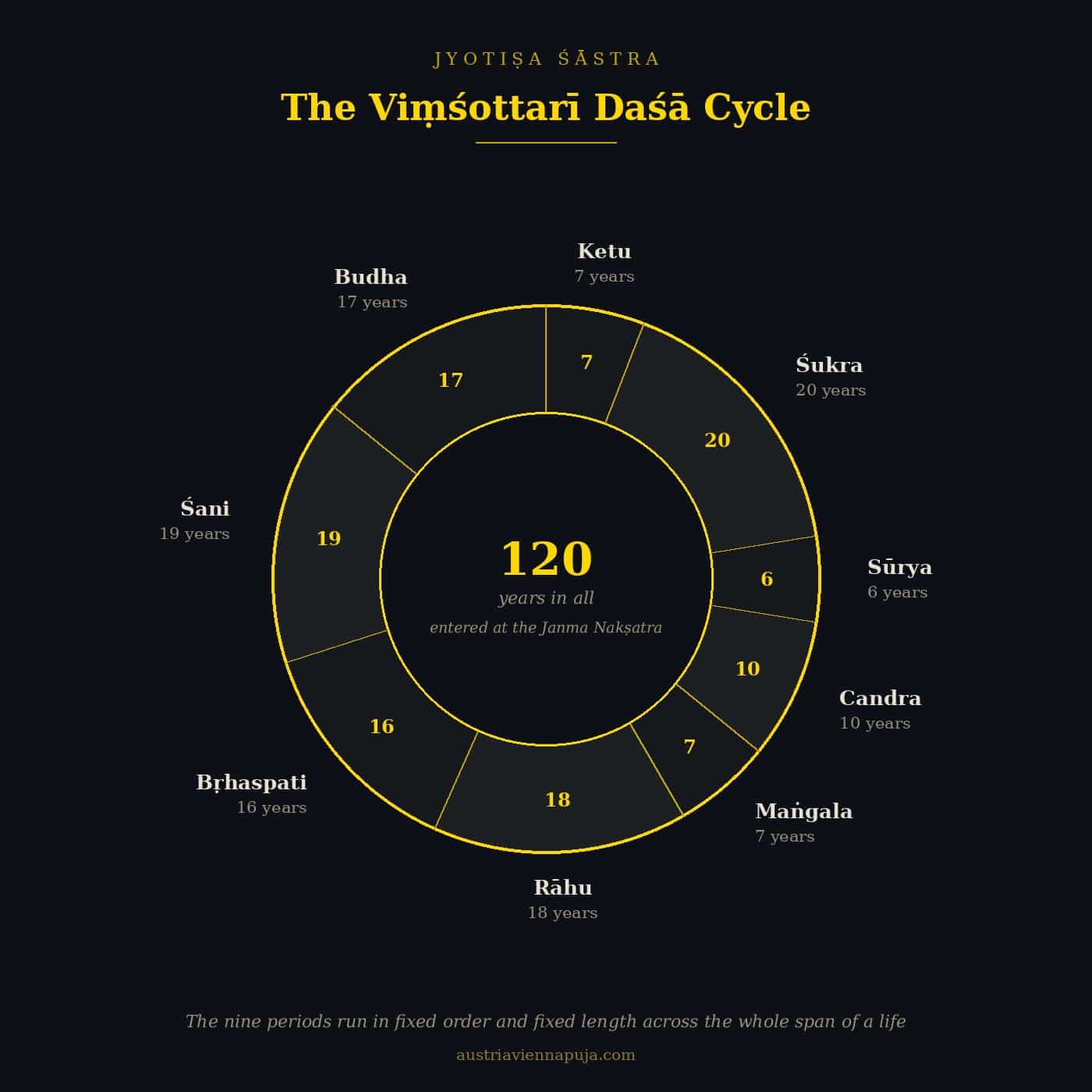
The nine periods of the Viṃśottarī Daśā, drawn to scale, running in fixed order across one hundred and twenty years.
Each major period, the Mahādaśā, is subdivided into Antardaśās governed in turn by each of the nine, and these subdivide again. A reader looking at a particular year is therefore looking at the interaction of at least two lords, and often three: what the governing Graha signifies, what it rules in this chart, how strong it is, and how it relates to the lord of the subdivision currently running. This is the machinery behind statements about timing, and it is why a reading can speak about a specific stretch of years rather than about a life in general.
Where Transit Enters, and How Little It Decides
The current positions of the Grahas in the sky, the Gocara or transits, are consulted, but they occupy a subordinate place that popular astrology inverts entirely. The tradition’s position is that a transit can only bring forward what the birth chart already contains and what the running period has already made available. A significant transit over a house whose lord is dormant in the current period produces far less than the same transit during that lord’s period. Reading transits without the period structure is the commonest error in amateur practice, and it is why generalized forecasts by sign are close to meaningless: they describe a transit affecting everyone identically, with no reference to the chart it lands on.
Yogas: Combinations That Modify the Whole
Finally, the tradition recognizes a large body of named combinations, the Yogas, in which particular relationships between Grahas or between house lords produce an effect exceeding what the parts would suggest individually. Some are formed by the association of the lords of fortunate houses, some by particular planets occupying particular positions relative to the Lagna or the Moon, some by patterns of distribution across the whole chart.
A responsible reader treats these with care, for two reasons. The classical texts describe the results of many Yogas in strong and sometimes extravagant terms that reflect the conventions of their genre rather than a promise to any individual. And a Yoga formed by weak or afflicted planets delivers little regardless of its name. The presence of a celebrated combination in a chart is the beginning of an assessment, not its conclusion, and a reading that announces such combinations without weighing their strength has mistaken a label for a judgment.
What the Reader Puts Together
A reading, then, is a synthesis rather than a lookup. The reader establishes the frame, identifies the lords and their condition, weighs their strength, checks the relevant divisional charts, locates the person within the period sequence, notes the Yogas and discounts them appropriately, and only then says anything. Where these lines of evidence converge, the statement can be made with confidence. Where they conflict, the honest course is to say so rather than to select whichever supports the more interesting sentence.
This is also why the remedial side of the tradition is approached with restraint. A prescription that follows from a careful assessment of a specific weak or afflicted placement is a different thing from a remedy applied to a planet’s name, and the difference accounts for most of the disappointment people report, as the discussion of why certain remedies do not work examines in detail.
A reading shows you the road and the horses. The reins, it leaves in your own hands.
ātmānaṃ rathinaṃ viddhi śarīraṃ ratham eva tu ।
buddhiṃ tu sārathiṃ viddhi manaḥ pragraham eva ca ॥
Know the Self as the rider in the chariot, the body as the chariot; know the intellect as the charioteer, and the mind as the reins.
KAṬHA UPANIṢAD 1.3.3
The Upaniṣad’s image describes the standing of the whole apparatus set out above. The chart may map the chariot and the road, the terrain a life will cross and the weather it will cross it in, but the Self remains the rider and the intellect the one who drives. Every procedure described here is instrumentation for seeing the road more clearly. None of it takes the reins, and a reading that presents itself as doing so has misunderstood the discipline it claims to practice.
The procedures described here follow the classical authorities of the Horā tradition, principally the Bṛhat Parāśara Horā Śāstra, with the source texts of the discipline gathered at Sanskrit Documents and scholarship on the Vedāṅga tradition available through the Oxford Centre for Hindu Studies.
© 2026 AUSTRIAVIENNAPUJA.COM · SANĀTANA DHARMA IN EUROPE
Preserving authentic Vedic transmission across the European continent