Jyotiṣa · The Eye of the Veda
Vedic Astrology in Europe: The Science of Time
What the tradition actually offers beneath the popular idea of prediction: not the forecasting of events, but the disciplined reading of time, of inherited tendency, and of the moment in which an action is best begun.
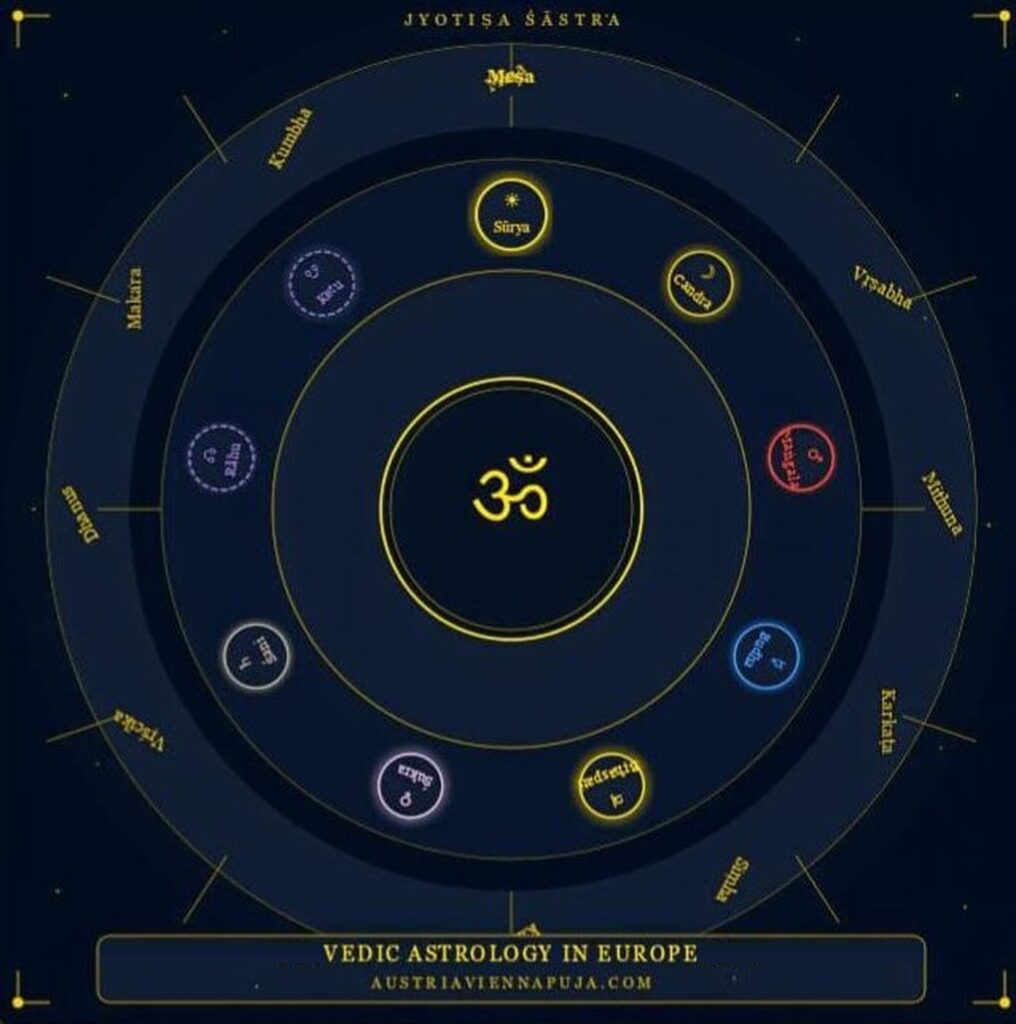
Vedic astrology in Europe: the Jyotiṣa Śāstra wheel, the nine Grahas set within the twelve Rāśis of the zodiac.
Most people who seek out Vedic astrology in Europe arrive with a particular expectation: that an astrologer will look at a chart and tell them what is going to happen. It is a reasonable expectation, since this is how astrology is almost universally presented. But it is not, in the main, what Jyotiṣa is, and the gap between the two is worth setting out plainly, because the thing the tradition genuinely offers is in some ways harder, and in every way more useful, than fortune-telling.
Jyotiṣa is, at root, a science of time. Its name is built from the word for light, the light of the heavenly bodies by which time was first measured, and its oldest recorded purpose was not to foretell a person’s future but to establish the correct moment for a sacred rite. From that single task the entire vast structure grew. To understand what a Vedic astrologer does, then, one must begin not with prediction but with this older and quieter idea: that time itself has texture, that not all moments are alike, and that a trained eye can read the difference.
Not Prophecy, but the Reading of Time
The popular image of the astrologer as a seer who announces fixed outcomes sits awkwardly with the tradition’s own texts. The foundational authority of Vedic natal astrology, the Bṛhat Parāśara Horā Śāstra, does not open with predictions. It opens with metaphysics: with an account of how the cosmos is structured, how the heavenly powers relate to the unfolding of a being’s life, and how the chart drawn at birth reflects what a person carries with them into this life. Prediction, where it appears at all, is a secondary and cautious activity, hedged with conditions.
The reason is doctrinal. In the tradition’s understanding, the chart does not impose a destiny; it describes a disposition. It maps the tendencies and the timing a person brings into embodiment, the terrain they will cross, much as a map of mountains and rivers tells a traveller what lies ahead without dictating how they will walk it. The honest astrologer is therefore not a prophet but something closer to a reader of conditions, who can say what the weather of a season is likely to be and counsel how to dress for it, while leaving the journey itself to the one who must walk it.
The chart is a map of the terrain, not a transcript of the journey. It shows what a season is likely to hold; how one crosses it remains one’s own.
This distinction matters practically, and not only doctrinally. An astrology that pronounces fixed verdicts encourages either complacency or despair, neither of which the tradition wishes upon anyone. An astrology that reads conditions and counsels response leaves a person freer and more responsible, not less. When a reading is conducted in this spirit, it becomes a form of guidance a thoughtful person can use, rather than a sentence to be endured or escaped.
Why It Is Called the Eye of the Veda
Jyotiṣa holds a particular dignity within the tradition: it is counted as one of the six Vedāṅgas, the auxiliary sciences that surround and serve the Veda, and within that group it is traditionally called the eye. The image is precise. Just as the eye allows the body to act in the right place, Jyotiṣa allowed the tradition to act at the right time. Every major rite, a marriage, an initiation, the entering of a new house, was to be performed at a moment determined by the astronomer-astrologer, because a rite performed at the wrong time was held to be compromised at its foundation.
It is worth distinguishing two layers within this single tradition. The oldest, the Vedāṅga Jyotiṣa, was essentially calendrical: its office was to fix the correct times for the sacred rites by the reckoning of sun, moon, and the lunar mansions. The natal or horā astrology represented by the Bṛhat Parāśara Horā Śāstra, the reading of an individual’s birth chart, is a later and more elaborate development, taking its mature form in the early centuries of the common era and showing some contact with the wider astronomy of the ancient world. Both belong to Jyotiṣa, but the calendrical office is the elder, and the natal art grew upon its foundation.
This origin tells us what Jyotiṣa is for. It was never, in its proper form, a parlour art for satisfying curiosity about the future. It was the timekeeping discipline of a civilisation that took time seriously, that believed the moment of an action shaped its outcome, and that built an extraordinarily sophisticated astronomy precisely so that its sacred life could be correctly placed within the turning of the heavens. The services a Vedic astrologer offers today, the reading of a birth chart, the choosing of a wedding date, the counsel in a difficult season, all descend directly from this single ancient office of telling the tradition when.
The Grahas: Powers, Not Planets
A point of vocabulary unlocks much of what follows. The nine Grahas of Vedic astrology are usually translated as the nine planets, but the word does not mean planet. It comes from a root meaning to seize or to grasp, and a Graha is understood as a power that takes hold of and governs a particular dimension of a person’s experience. Seven of the nine correspond to bodies one can see, the Sun, the Moon, and the five visible planets, but two, Rāhu and Ketu, are not bodies at all; they are the two points where the Moon’s path crosses the Sun’s, mathematical points with no substance, yet treated as full Grahas with their own character and meaning.
That two of the nine have no physical body is the clearest sign that the astrologer is not, in the tradition’s own conception, calculating the physical pull of distant objects. He is reading the heavens as a kind of script, in which the positions of these powers at the moment of birth correspond to the tendencies and timing a person carries. Each Graha governs a domain: the Sun the sense of self, the Moon the feeling mind, others the will, the intellect, wisdom, refinement, and the long discipline of consequence. To read a chart is to read how these powers were arranged at one’s first breath, and what that arrangement inclines toward.
The Chart as a Map, Not a Sentence
The birth chart, the Janma Kuṇḍalī, is drawn from the exact time and place of birth, and its most sensitive element is the point of the zodiac rising on the eastern horizon at that moment, the Lagna or ascendant. Because the heavens turn a full circle each day, the ascendant moves quickly, which is why an accurate birth time matters so much; a difference of a couple of hours can shift the whole structure of the chart. Around this rising point the twelve houses are arranged, and each house governs an area of life, the body and temperament, wealth and speech, home and mother, partnership, work and standing, and so through the whole field of a human life.
What gives Vedic astrology its distinctive temporal precision, and what most sets it apart from other systems, is the doctrine of unfolding periods, the Daśās. Rather than reading only the present sky, the tradition holds that the chart releases its content in a fixed sequence of periods, each governed by one of the Grahas, across the span of a life. One lives, in effect, through chapters: a long chapter ruled by one power, then another, each bringing forward the tendencies that power carries in one’s particular chart. A great deal of what a reading offers is simply this: an understanding of which chapter one is in, what it tends to ask, and what is likely to come next, so that one meets a season knowingly rather than blindly.
None of this is a sentence to be served. The tradition is explicit that what the chart shows is the portion of one’s accumulated tendencies that has ripened for this life, and that how one responds, the conduct one chooses, the effort one makes, remains genuinely one’s own and genuinely consequential. The chart sets the stage; the person still acts upon it. A reading that forgets this has misunderstood its own foundation. A fuller account of what a single chart contains, and how it is read in depth, is given in the dedicated treatment of the birth chart reading.
Choosing the Moment: Muhūrta
Of all the services a Vedic astrologer provides, the choosing of an auspicious moment, the Muhūrta, is the oldest and, in daily practice, the most used. It rests on the conviction set out at the start of this page: that time has texture, that some moments carry a quality favourable to a particular undertaking and others do not, and that beginning something at a well-chosen moment sets it on better ground. This is why families seek a Muhūrta for a wedding, for moving into a home, for a child’s first rites, and for other significant beginnings.
The calculation draws on the traditional almanac, which describes the quality of a given day through several dimensions at once, the lunar day, the weekday and its ruling power, the lunar mansion the Moon occupies, and further combinations. A skilled astrologer weighs these together, and weighs them further against the birth chart of the person principally concerned, since a moment that is generally favourable may still hold friction for a particular individual. The choosing of a wedding date in this way, and how it bears on the marriage that follows, is treated alongside the question of chart compatibility in the account of chart matching for Hindu marriages.
When a Reading Suggests a Remedy
A reading that identifies a difficult configuration does not simply name it and leave the person with the burden of knowing. The tradition pairs its analysis with Upāya, remedial measures intended to help one meet a hard season with more steadiness. These fall into recognised categories: the recitation of particular sacred formulae addressed to the power concerned; acts of giving and service directed toward what that power governs; and, for more serious matters, fire offerings conducted by a qualified priest. Of these, the tradition gives the first place to the spoken sacred word, the Mantra.
Here a measure of honesty is owed, and the tradition itself supplies it. A remedy is understood within the framework of conduct and effort, not as a mechanism that overrides them. It is not a transaction by which a payment or an object purchases a fixed result, and any reading that presents it so has stepped outside the spirit of the science. The deepest remedy the tradition recognises is the steady practice of one’s duties and the cultivation of one’s character; the prescribed observances are aids to that, not substitutes for it. The reasons this matters, and why remedies sold as guaranteed fixes so often disappoint, are examined directly in the discussion of why certain remedies do not work.
Reading a Chart From Europe
A natural question for those living in Europe is whether a reading conducted far from where this science developed is in any way diminished. It is not. Jyotiṣa reads time and the heavens, and neither is bounded by geography; a chart drawn for a person born in a European city records their life as faithfully as one drawn for a person born anywhere else, and the same tools read it.
One Technical Point
The single thing that genuinely requires care in the European setting is the calculation of local time. A birth chart, and above all a Muhūrta, depends on the sunrise, sunset, and sky as seen from the actual place, so the figures must be computed for the latitude and longitude of the European city in question, not borrowed from an Indian reference. This is ordinary competence rather than a difficulty; it simply needs to be done correctly. The analysis itself, and a consultation conducted at a distance by voice or video, lose nothing for being far from the tradition’s homeland.
What this means in practice is that a family in Europe need not feel they are receiving a lesser version of the tradition. The reading they receive is the reading; only the clocks are local.
The astrologer does not tell you your fate. He tells you the hour, the season, and the weather, and leaves the walking to you.
kālaḥ pacati bhūtāni kālaḥ saṃharati prajāḥ
kālaḥ supteṣu jāgarti kālo hi duratikramaḥ
“Time ripens all beings, Time gathers the creatures in; Time is awake while all things sleep, for Time is hard to overcome.”
MAHĀBHĀRATA · A REFLECTION ON TIME
That ancient reflection on Time names the very thing Jyotiṣa exists to read. The tradition did not regard time as an empty container in which events merely happen; it regarded it as a power, qualitative and consequential, before which the wise learn to act with discernment rather than against the current. A Vedic astrologer is, in the end, one trained to read that current: to say what the hour favours, what the season is likely to bring, and how a person may meet it well. The rest, as it always has, belongs to the one who lives the life.
The doctrine described here rests on the classical authorities of Jyotiṣa: the principal text, the Bṛhat Parāśara Horā Śāstra, together with the astronomical foundation preserved in the Sūrya Siddhānta, with further source texts gathered at Sanskrit Documents and scholarship on the Vedāṅga tradition available through the Oxford Centre for Hindu Studies.
© 2026 AUSTRIAVIENNAPUJA.COM · SANĀTANA DHARMA IN EUROPE
Preserving authentic Vedic transmission across the European continent