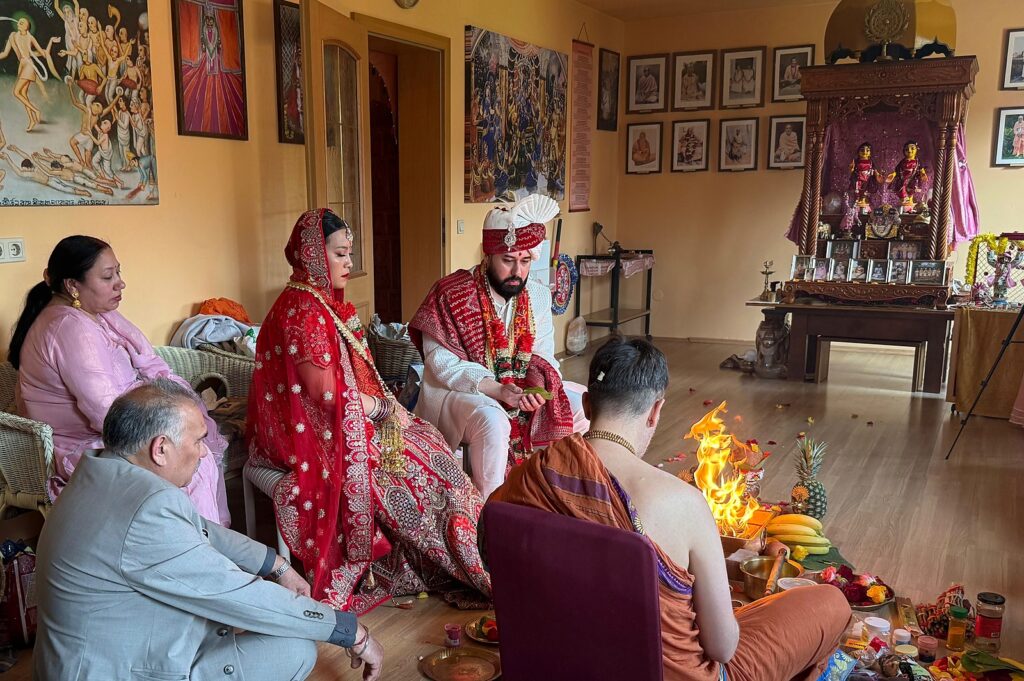
Vivāha Saṃskāra: The Śāstric Architecture of Authentic Hindu Wedding Ceremonies in Europe
A doctrinal exposition of Vivāha Saṃskāra as the Vedic foundation of authentic Hindu wedding ceremonies in Europe, examined through the Gṛhya Sūtras, the Manusmṛti, the Yājñavalkya Smṛti, and the Āśvalāyana and Pāraskara ritual manuals that govern the precise architecture of the marital Saṃskāra.
What makes a Hindu wedding ceremony in Europe authentic is not its décor, its regional cuisine, or the languages spoken among the guests. The Dharmaśāstra tradition settled the question long ago, and its answer is exact: a Hindu wedding is authentic when it is performed as a Vivāha Saṃskāra, one of the sixteen sacramental consecrations through which the embodied Jīva is formed across the whole of its lifespan. The Vivāha is not a celebration that borrows Vedic vocabulary for atmosphere. It is a rite of Mantra and Agni whose validity rests on a tightly specified ritual architecture preserved in the Gṛhya Sūtras and the principal Smṛtis. A wedding that sets this architecture aside may yield a beautiful afternoon; what it does not yield is a Vivāha.
This treatise sets out the doctrinal foundations of the Vivāha Saṃskāra for couples and families undertaking Hindu marriages in the European Deśa. For the procedure it draws on the Āśvalāyana Gṛhya Sūtra and the Pāraskara Gṛhya Sūtra; for the classification of marital forms and the regulation of married conduct, on the Manusmṛti and the Yājñavalkya Smṛti; and throughout, on the Sanātanī understanding of Saṃskāra, Mantra, and Agni-Sākṣī as the elements that render a wedding Vedically valid wherever it is performed.
Pūrvapakṣa — The Modern Reduction of Vivāha to a Cultural Performance
Why the “Cultural Heritage” Reading Fails Doctrinally
The dominant modern reading treats a Hindu wedding as a vivid cultural inheritance, an aesthetic encounter with ancestral colour, music, and ceremony, undertaken because the couple wishes to honour where they come from. On this view the Mantras are atmospheric, the Vedī is decorative, and the priest is a master of ceremonies whose task is to render ancient gestures legible to a modern audience. So understood, the ceremony is meaningful in the way any cherished tradition is meaningful, yet it makes no particular claim upon the cosmos or upon the life the couple will go on to lead.
Such a reading does not match what the Śāstras say of the Vivāha. The Gṛhya Sūtras describe not a cultural performance but a precise sequence of acts whose Mantric force constitutes the marital relation in its Vedic form. The Manusmṛti is plain that until the Saṃskāra is performed the union of a man and woman is not yet Vivāha, however many witnesses attend or however elaborate the surrounding gathering. The cultural reading keeps the surface and lets the substance go, mistaking the body of the rite for its soul.
Why Civil Marriage Cannot Substitute for Vivāha Saṃskāra
A related modern position holds that civil registration before the competent European authority is enough, and that the religious ceremony may be added as a personal commemoration or left out altogether. The civil registration is, of course, indispensable for the legal standing of the union within the host state, and the Dharmaśāstra has no quarrel with it. Yet the civil act and the Vivāha Saṃskāra belong to different orders. The first establishes a contractual relationship within state law; the second establishes a Karmic, Mantric, and Devic relationship within the cosmic order of Ṛta.
The Yājñavalkya Smṛti acknowledges this layering clearly enough. Civil and customary law govern the public face of the union; the Vivāha governs its sacramental depth. The two serve different ends and neither answers for the other. A couple that has completed the civil registration has satisfied the juridical requirement and that alone. The Karmic, ancestral, and Devic dimensions of their union remain unconsecrated until the Vivāha Saṃskāra is performed by a qualified Ṛtvij, with the prescribed Mantras, before the Vedic fire. The two acts stand side by side; the civil does not stand in for the sacramental.
The Doctrinal Identity of Vivāha as a Saṃskāra
Vivāha within the Sixteen Saṃskāras
The sixteen Saṃskāras of the Sanātana Dharma form the sequence by which the Vedic tradition shapes the Jīva from conception to cremation, and within that sequence the Vivāha holds a place of its own. It is the threshold at which the Jīva, having completed its formation as a Brahmacārin under the Veda, enters the Gṛhastha Āśrama, the householder station that sustains the other three through the Pañca-Mahā-Yajñas and through the raising of the next Dharmic generation. The Smṛtis are candid about the dependence here: without Gṛhastha there is no support for the student, the forest-dweller, or the renunciant. Seen in this light the Vivāha is never merely a private matter between two persons; it is the sacramental act on which the whole Āśrama order of society rests.
For the full architecture of the sixteen Saṃskāras and their significance across the Jīva’s lifespan, the reader may consult the dedicated treatment of Saṃskāras in the Sanātana Dharma. The Vivāha is best understood within that larger arc rather than on its own, for it opens the householder phase, and whatever conditions make it valid are the same conditions that ground the householder Dharma to follow.
The Gṛhya Sūtras and the Ritual Procedure
The procedure of the Vivāha is preserved with technical care in the Gṛhya Sūtras of the principal Vedic schools. The Āśvalāyana Gṛhya Sūtra, belonging to the Ṛgvedic tradition, lays down the sequence followed by Ṛgvedī families: the kindling of the nuptial fire, the Madhuparka offered to the bridegroom, the marital Mantras of the Ṛgveda Maṇḍala X, the Pāṇi-grahaṇa, the Lāja-homa, and the Sapta-Padī. The Pāraskara Gṛhya Sūtra, belonging to the Śukla Yajurveda, gives the parallel sequence with the Mantras and emphases of its own tradition. The Khādira Gṛhya Sūtra preserves the Sāmavedic variant, and the Hiraṇyakeśin and Āpastamba Gṛhya Sūtras those of the Kṛṣṇa Yajurveda.
The implication matters. There is no single uniform procedure imposed on every family; rather there is one essential architecture transmitted within each Vedic school, carrying the Mantras and emphases proper to that school. A qualified Ṛtvij, then, is not merely someone acquainted with the general shape of a Hindu wedding. He is one who can perform the Vivāha according to the Gṛhya Sūtra of the family’s own Veda-Śākhā, placing each Mantra exactly where the Sūtra directs. Authenticity, in the Śāstric sense, is precisely this fidelity, and it marks the line between a true Vivāha Saṃskāra and a graceful ceremony shaped only to resemble one.
The Eight Forms of Vivāha in the Dharmaśāstra
The Four Praśasta Forms and the Four Aprasasta Forms
The Manusmṛti gathers the historically attested forms of marriage into eight: Brāhma, Daiva, Ārṣa, Prājāpatya, Āsura, Gāndharva, Rākṣasa, and Paiśāca. The first four are generally counted Praśasta, approved and auspicious for the lineage, and the latter four Aprasasta, disapproved or condemned in differing degrees and held to bring varying grades of Karmic encumbrance upon the offspring. The commentators do not all agree on the Gāndharva form, the union of mutual consent, which several authorities allow for the Kṣatriya and treat as valid wherever it is completed by the full Vedic procedure. The Smṛti here is not policing private preference; it is recording how the tradition understood the formation of marriage, and which modes of union it took to open the auspicious flow of Pitṛ and Devatā blessing across a lineage rather than to obstruct it.
In the Brāhma form a learned bridegroom, invited by the bride’s father and received with honour, is given the daughter without conditions and joined to her through the complete Vedic procedure. The Daiva form gives the daughter to a priest officiating at a Yajña. In the Ārṣa form the bridegroom presents a cow and a bull to the bride’s father, received in fulfilment of sacred duty and not as a price paid for the bride. The Prājāpatya form is sealed by the father’s charge that the couple discharge their Dharma together. What these four share is consecrated giving within Vedic procedure, and that shared element is the doctrinal heart of the Vivāha Saṃskāra.
Why the Brāhma Vivāha Remains the Śāstric Standard
Of the eight, the Brāhma Vivāha is the measure against which the rest are judged, and the form the Smṛtis commend to the contemporary Sanātanī householder wherever it can be followed. Its mark is the unconditional Kanyādāna set within the full Vedic sequence before Agni, the bride’s father invoking the lineage and the bridegroom receiving her with the Vedic Mantras of acceptance. The Smṛtis regard the Karmic flow it opens for the descending generations as the most auspicious, since every element of the rite is present in complete and undiluted form: the qualified Ṛtvij, the Vedī, the kindled Agni, the recited Mantras, the unconditional offering, the Pāṇi-grahaṇa, the Sapta-Padī, and the witnessing presence of the Devatās the Mantras invite. This is the Vivāha the Śāstras call complete.
The Ritual Architecture of the Authentic Hindu Wedding
Agni as the Sākṣī of the Vivāha
The Vivāha is performed before Agni, the Vedic fire kindled with the prescribed wood, fed with the prescribed Samidhs, and consecrated with the prescribed Mantras. Agni is the Sākṣī, the witness, though the Vedic sense of witnessing is not the passive watching of a bystander. In the understanding the tradition has long carried, Agni is the messenger between the seen and the unseen: what is offered into the fire is borne to the Devatās, and what is pledged before it is taken up into the order it serves. The Vivāha Mantras are addressed through Agni to Indra, to the Aśvins, to Bhaga, to Aryaman, to Pūṣan, and to the Pitṛs of both lineages, inviting these powers to attend the rite, to confirm the union, and to bestow the protective and generative blessings the Saṃskāra seeks.
For this reason a Vivāha cannot proceed without a fire properly kindled and properly kept. The kindling is no mere prelude to the marriage; the living Agni is the very channel through which the Vivāha becomes what it is, and where no fire is present the Mantras have no medium to carry them and the Saṃskāra does not take form. On this the Gṛhya Sūtras are explicit. A Vivāha conducted without the prescribed fire is, in Śāstric terms, an incomplete rite.
Kanyādāna and the Doctrine of Gotra Transmission
Kanyādāna, the giving of the daughter by her father or the responsible male relative of her natal family, is the act by which, in the dominant Smṛti teaching, the bride’s passage between two Gotras is sacramentally accomplished. The Gotra is the patrilineal Ṛṣi-lineage to which a Sanātanī family belongs, and the tradition treats it as the channel along which Vedic transmission, Pitṛ observance, and ancestral continuity flow. At the Kanyādāna, on this understanding, the bride passes from her father’s Gotra into her husband’s. The Smṛtis present this not as a sentiment but as a real change in the lineage to which she now belongs, which is why the Saṅkalpa, the formal Mantric declaration of intent, names the Gotras of both parties together with the time, the place, and the purpose of the rite.
The Kanyādāna is preceded by a verification of Gotra compatibility, undertaken alongside the wider astrological assessment. The two parties are required to belong to different Gotras and to satisfy the conditions of Sapiṇḍa exogamy laid down in the Smṛtis. How these matters are properly handled before a Vivāha is undertaken is treated in the dedicated discussion of Kundli matching for Hindu marriages, where the Aṣṭakūṭa and Gotra verifications suited to a European-conducted Vivāha are set in their doctrinal context.
Pāṇi-grahaṇa and the Mantric Core of the Union
After the Kanyādāna comes the Pāṇi-grahaṇa, the bridegroom’s taking of the bride’s hand as the foundational Mantra of the Vivāha is pronounced: Gṛbhṇāmi te saubhagatvāya hastam, “I take your hand for the sake of auspicious fortune.” Preserved in the Ṛgveda Maṇḍala X and carried into every Gṛhya Sūtra’s Vivāha sequence, this Mantra lies at the heart of the marital bond. With its utterance the two become Sahadharmacāriṇau, companions in the upholding of Dharma. The hand taken here is not let go until the Sapta-Padī is done, marking the unbroken thread of the rite from invocation to its sealing. Through the joined right hands of bride and bridegroom pass the Mantras of acceptance, of fidelity, of mutual support, and of the shared pursuit of the four Puruṣārthas, settling into the life of both.
Sapta-Padī and the Sealing of the Saṃskāra
The Sapta-Padī, the seven steps the couple take together beside Agni, is held by the Manusmṛti and the Gautama tradition to be the point at which the Vivāha is sealed and made binding; on this view the rite is still in progress until the seventh step is taken. It should be noted that the Smṛtis are not wholly of one voice here, and other authorities locate the binding moment earlier, at the Pāṇi-grahaṇa or the Lāja-homa. What the texts agree on is the gravity of the seven steps themselves, each accompanied by a Mantra naming a dimension of the shared life now beginning: Iṣe ekapadī bhava (be one in nourishment), Ūrje dvipadī bhava (be one in strength), Rāya-spoṣāya tripadī bhava (be one in growing prosperity), Māyobhāvāya catuṣpadī bhava (be one in the cultivation of joy), Prajābhyaḥ pañcapadī bhava (be one in offspring), Ṛtubhyaḥ ṣaṭpadī bhava (be one through the seasons), and Sakhā saptapadī bhava (be a friend of seven steps).
The Mantras name the levels of married life in ascending subtlety. The first three speak to its material grounds, nourishment, strength, prosperity. The fourth and fifth turn to the affective and the procreative. The sixth reaches to continuity across the seasons and stages of a life. The seventh names the deepest level of all, Sakhā, the friendship that holds the relation together in its mature form, when the early urgencies have softened into something quieter. Taken whole, the Sapta-Padī is the blueprint for the entire course of marriage as the Śāstras envision it.
Muhūrta — Why the Hour of the Vivāha Matters
The Muhūrta, the astrologically chosen auspicious hour, is no small matter in the Vivāha. The Jyotiṣa Śāstra reads the cosmos as a field of shifting Graha influences whose strengths rise and wane, and it identifies the windows of time in which the planetary pattern favours the act being undertaken. The Vivāha Mantras call upon particular Devatās, and the tradition holds the strength of those powers at the moment of invocation to be bound up with the planetary positions of that moment. To take the Saptapadī when the relevant Grahas are weak or afflicted is, on this reckoning, to work through a diminished medium.
For a Vivāha in the European Deśa the Muhūrta is reckoned from the local longitude and latitude, the Pañcāṅga limbs of Tithi, Vāra, Nakṣatra, Yoga, and Karaṇa being determined for the European horizon rather than the Indian one. The Pañcāṅga itself is unchanged; only the place of reckoning differs. This too is a principle of the Jyotiṣa Śāstra, that the calculation follows the place where the rite will be performed, since the Grahas are seen from there. A wedding in Europe does not borrow its Muhūrta from Ujjayinī; it is computed afresh for the local horizon. Done competently, such a reckoning sets the Vivāha in Europe on the same astrological footing as one in Bhārata.
Vivāha in the European Deśa — The Question of Sacred Geography
Deśa-Kāla and the Adaptation of Place
A real doctrinal question faces any Vivāha performed beyond the bounds of Bhārata: is a Saṃskāra in the European Deśa Vedically valid? The Dharmaśāstra answers through the doctrine of Deśa-Kāla and, where circumstances are straitened, the provisions of Āpaddharma. A valid Saṃskāra calls for certain things: a qualified Ṛtvij who knows the Mantras and the Gṛhya Sūtra procedure of the family’s school; a properly built Vedī; a fire properly kindled and fed with permissible Samidhs; the prescribed Mantras spoken in the prescribed order; and the willing presence of the couple and the responsible relatives. These are the conditions of validity. The place where they are gathered is not, of itself, among them.
The Yājñavalkya Smṛti and the Parāśara Smṛti alike allow that where the conditions of a Vedic rite can be met the rite may be validly performed, and where they cannot it is to be deferred or adapted under Āpaddharma. In Europe every one of those conditions can in fact be met. A qualified Ṛtvij can come to the place; a Vedī can be built to specification; Agni can be kindled with fitting Samidhs; the Mantras can be spoken according to the family’s Gṛhya Sūtra. A Vivāha so performed anywhere in the European Deśa is, in doctrine, a Brāhma Vivāha and not a thinned imitation of one. The Deśa-Kāla principles bearing on Hindu observance in Europe are developed more fully in the broader account of Sanātana Dharma as a way of life.
The Construction of a Valid Vedī Beyond Bhārata
The Vedī, the sacred altar that holds the Agni, is built to Śāstric specifications that owe nothing to location. It is raised in the prescribed proportions, oriented to the cardinal directions as determined at the site of the rite, and consecrated with the Mantras of bhūmi-pūjana and dik-bandhana. A garden, a hall, or a pavilion by the water anywhere in Europe will serve equally for a Vedī properly made. What is required is that the proportions be correct, the orientation observed, the Sāmagrī genuine, and the consecrating Mantras spoken. Where these hold, the ground beneath the Vedī becomes the sacred Kṣetra for the span of the rite, whether that ground lies in Vārāṇasī or in Europe. The Ṛta-principle takes no notice of political borders; it answers only to faithful conformity with its own pattern.
Vivāha as a Lifelong Sādhana, Not a Single-Day Event
The Vivāha Saṃskāra opens a Sādhana that runs the length of the householder life. The Mantric forces set in place at the Saptapadī are not spent on the day; they are renewed through the daily observances of the Gṛhastha Āśrama. The Pañca-Mahā-Yajñas, the five daily offerings to Brahman, Pitṛ, Deva, Bhūta, and the guest, continue what the wedding began. The Āvasathya or Aupāsana Agni, the household fire the Gṛhya Sūtras direct the couple to establish at the time of the wedding and to tend thereafter, is its enduring material trace. The daily Sandhyā Vandanā, the periodic Pitṛ-Tarpaṇa, and the yearly observance of the family’s ancestral and Iṣṭa-Devatā festivals are all the householder’s keeping-up of the consecration the Vivāha set in motion.
A Vivāha without this following Sādhana is only partly realised. The Saṃskāra has been validly performed and its Mantric seed laid down, yet the seed comes to its full strength only through the couple’s sustained life in the Dharmic observances of the householder station. The Brāhma Vivāha is no single blessing conferred and forgotten; it opens a field the couple is asked to enter and to tend across the years. The Saṃskāra is the seed and the Gṛhastha Dharma the cultivation, and the fruit waits on both.
Gṛbhṇāmi te saubhagatvāya hastaṃ mayā patyā jaradaṣṭir yathāsaḥ ।
Bhago aryamā savitā purandhir mahyaṃ tvādur gārhapatyāya devāḥ ॥
Ṛgveda 10.85.36 — The Pāṇi-grahaṇa Mantra of the Vivāha Saṃskāra
Siddhānta — The Doctrinal Conclusion
Vivāha as the Threshold of the Gṛhastha Āśrama
The Vivāha Saṃskāra is the threshold at which the Vedic Jīva passes from Brahmacārya into Gṛhastha and takes up the Dharmic charge of sustaining the four Āśramas through the Pañca-Mahā-Yajñas and the raising of the next generation. Authenticity in a Hindu wedding lies, then, not in scenic décor or in geographic origin but in the careful gathering of the rite’s conditions: a qualified Ṛtvij, a fire properly kindled, a Vedī correctly built, the Mantras of the family’s Vedic school, and the unbroken passage from Kanyādāna through Pāṇi-grahaṇa to the seventh step. These conditions can be assembled in Europe with the same fidelity as in Bhārata.
The Continuity of the Saṃskāra into the Householder Life
Nor is the Vivāha used up in its own day. The Saptapadī seals a consecration whose keeping is the labour of the whole householder phase, carried on through the Pañca-Mahā-Yajñas, the Āvasathya Agni, the daily Sandhyā, the Pitṛ-Tarpaṇa, and the disciplined pursuit of the four Puruṣārthas under Dharma. The couple who grasps this enters the Vivāha not as the consumers of a single event but as the heirs of a lifelong Sādhana, its foundation laid before Agni on that day and its pattern the very pattern of the Sanātana Dharma.
The Final Teaching
An authentic Hindu wedding in Europe is one in which the Vivāha Saṃskāra is performed with the full integrity the Gṛhya Sūtras prescribe. The geography is incidental; the conditions are everything. When the Ṛtvij is qualified, the Vedī correctly raised, Agni properly kindled, the Mantras of the family’s Veda-Śākhā spoken at their appointed moments, and the couple led through the Saptapadī with its Mantra at every step, the Vivāha has occurred. The fire has carried the offering, the Devatās have been called to witness, and the Pitṛs of both lineages have received their share. The couple has become Sahadharmacāriṇau in the exact sense the Smṛtis intend. The wedding is no longer one event among the events of their lives; it is the ground their householder life is built upon.
Scholarly References
- ✦Āśvalāyana Gṛhya Sūtra, primary Ṛgvedic source for the procedure of the Vivāha Saṃskāra, including Pāṇi-grahaṇa, Lāja-homa, and Sapta-Padī (WisdomLib).
- ✦Pāraskara Gṛhya Sūtra, Śukla Yajurvedic ritual manual preserving the parallel Vivāha sequence and Mantric architecture (WisdomLib).
- ✦Manusmṛti with the commentary of Medhātithi, doctrinal source for the eight forms of Vivāha and the classification of Praśasta and Aprasasta marriages (WisdomLib).
- ✦Stanford Encyclopedia of Philosophy — Śaṅkara, scholarly treatment of the Vedāntic framework of Dharma, Karma, and the Āśrama order underlying the Saṃskāra tradition.
- ✦Oxford Centre for Hindu Studies, peer-reviewed scholarship on the Vivāha Saṃskāra and the Vedic domestic ritual corpus.
© 2026 AUSTRIAVIENNAPUJA.COM · SANĀTANA DHARMA IN EUROPE
Preserving authentic Vedic transmission across the European continent