Introduction Beyond Ritual | The Shastric Logic of Gayatri Mantra Sandhyavandanam
The Gayatri Mantra Sandhyavandanam Shastric significance cannot be understood merely as part of religious tradition. It is an ancient spiritual technology designed to synchronize human awareness with cosmic order. Far from being a mechanical routine,Gayatri Mantra Sandhyavandanam acts as the bridge between Rta (cosmic law) and Dhi (illumined intellect).
As described in the Smritis and Vedic commentaries, chanting the Gayatri Mantra during the three junctions of the day sunrise, noon, and sunset is not symbolic; it’s scientific in its own metaphysical logic. It restores balance in body, speech, and mind while aligning the practitioner’s inner rhythm with the motion of the solar orb, Savitur, the source of illumination.
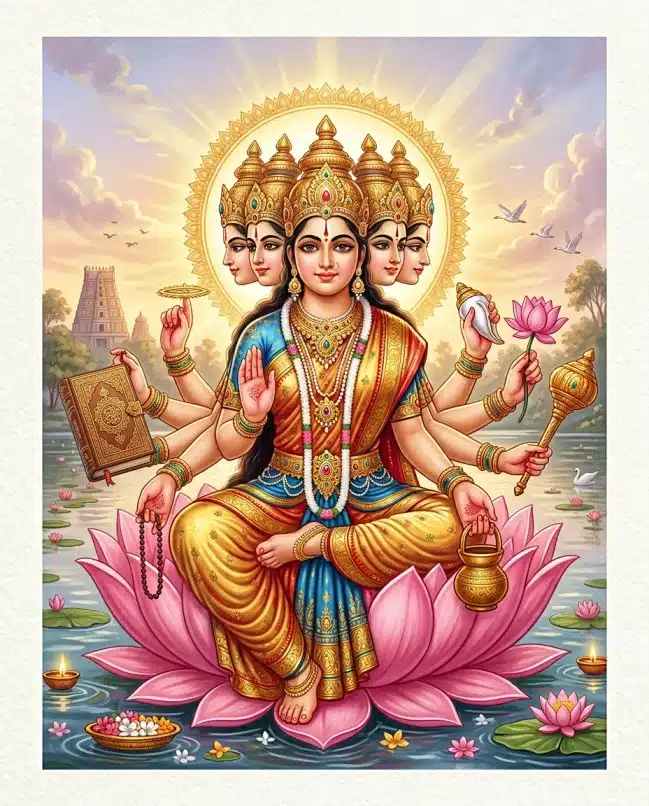
What Is Sandhya? The Sacred Junction of Light and Shadow
In Sanskrit, Sandhya literally means “junction” or “meeting point.” The day isn’t viewed as a continuous stretch but as a sacred cycle punctuated by natural thresholds the meeting of light and shadow.
According to the Manusmriti (4.92) and references in the Taittiriya Aranyaka, Sandhya Kala is a potent period where the energies of darkness and light interact. The ancient sages discovered that the human mind, being a microcosm of the Universe, becomes highly receptive and stable when tuned during these junctures.
The Gayatri Mantra Sandhyavandanam Shastric significance thus lies in harmonizing the human bio-energetic structure with the cosmic solar current. Chanting at these precise moments infuses one’s Prana with the rhythm of Savitur the divine impeller of consciousness.
The Three Daily Sandhyas: A Shastric Breakdown
Vedic texts identify three key Sandhya periods, each reflecting a distinct solar energy and divine principle. Let’s examine each from the scriptural lens.
1. Pratah Sandhya (Morning Transition)
At dawn, the Sun appears as Brahma, the Creator. The energy at this hour is transparent, creative, and expansive. The Brahma Muhurta, which occurs before sunrise, is described in the Brihadaranyaka Upanishad as the ideal time to invoke wisdom and clarity.
Purpose: Purification of impressions from the night and activation of intellect (Dhi).
Effect: Awakens inner radiance and removes Tamas (inertia).
Shastric Reference: The Taittiriya Brahmana prescribes Gayatri Japa as an act of soul reawakening.
Modern Insight: This practice optimizes mental agility think of it as aligning your brain’s “operating system” with the solar CPU.
2. Madhyannika (Noon Transition)
At noon, the Sun manifests as Rudra or Ishwara, representing intensity and active transformation.
Purpose: Internal stabilization amidst external activity.
Effect: Refines ego tendencies, ensuring decisions stem from wisdom rather than impulse.
Shastric Reference: The Yajnyavalkya Smriti calls this a vital juncture to renew one’s connection with Rta the cosmic rhythm underlying existence.
Advanced Perspective: Noon worship channels vital solar energy to sustain vitality. While others pause for lunch, the Sandhyavandana practitioner pauses for renewal.
3. Sayam Sandhya (Evening Transition)
As the day declines, the Sun transforms into Vishnu, the Preserver. This is a time for introspection and gratitude.
Purpose: Integration of experiences; returning the results of one’s Karma to the divine source.
Effect: Dissolves agitation and restores emotional equilibrium.
Scriptural Basis: The Manava Dharma Shastra associates evening prayer with cleansing the mental field before rest.
Analogy: Just as the sky transitions from light to night, the mind transitions from activity to peace through this contemplative act.
The Function of “Dhi” in the Gayatri Mantra
In the Gayatri Mantra, the phrase “Dhiyo Yo Nah Prachodayat”—“May He inspire our intellects” points directly to the operation of Dhi, the higher faculty of discrimination.
Shastras describe Dhi as the “antenna” of consciousness, which receives divine intelligence. The regular discipline of chanting, therefore, refines this inner instrument, enhancing subtle perception and ethical discernment.
In contemporary terms, we might liken Dhi to the brain’s “executive control center,” sharpened through disciplined focus and rhythmic regulation.
When the Gayatri Mantra Sandhyavandanam is practiced sincerely, the Gayatri acts as both mantra (vibrational invocation) and yantra (astral mechanism), stimulating the pineal and pituitary systems, which regulate circadian balance.
The Power of the Maha Vyahritis
Before chanting the Gayatri, practitioners recite the Maha Vyahritis Bhuh, Bhuvah, and Svah. According to the Taittiriya Upanishad, these represent the three planes of existence:
Bhuh – the physical realm (Earth plane)
Bhuvah – the vital realm (Pranic or astral)
Svah – the celestial realm (causal plane)
Each utterance harmonizes the individual consciousness with one layer of cosmic manifestation. The Gayatri Mantra Sandhyavandanam Shastric significance thus expands far beyond words it is experiential yoga. The practitioner moves from the gross to the subtle, from limitation to expansiveness.
This process is more than devotion it is spiritual engineering. Just as an engineer designs systems in alignment with physical laws, the Sandhyavandana practitioner aligns consciousness with universal law.
Arghya Pradana: The Science of Offering Water
No discussion of this practice is complete without the Arghya Pradana, the ritual of offering water to the Sun. The Taittiriya Aranyaka narrates that malicious entities the Mandehas attempt to obscure the solar light every morning. Symbolically, these represent our inner darkness’s: ignorance, fatigue, negativity.
When water is offered while chanting the Gayatri, it transforms into a subtle energy weapon, a Vajra (thunderbolt), annihilating these inner demons. In the language of psychology, it purifies subconscious patterns that resist growth.
This daily act of Arghya connects ecology with spirituality. Pouring water to the rising Sun fosters reverence for the environment and acknowledges our dependency on natural cycles. In a world struggling with climate imbalance, this simple act becomes an ecological gesture of gratitude.
Scriptural Sources on Shastric Obligation (Nitya Karma)
The Vedas categorize actions into three types: Nitya (obligatory), Naimittika (occasional), and Kamya (desire-based). Sandhyavandanam falls under Nitya Karma. Ignoring it is considered a subtle spiritual debt because one misses alignment with Rta—the universal order sustaining all existence.
The Chandogya Upanishad declares that those who perform Sandhya are verily performing Jnana Yajna, the sacrifice of knowledge. Each act becomes a means of remembering the Oneness that pervades all.
Thus, the Gayatri Mantra Sandhyavandanam Shastric significance is not sectarian it is universal, for it harmonizes the solar intelligence within all sentient beings.
Modern Relevance: Gayatri in the Age of Over-stimulation
In 2026, humanity faces unprecedented levels of distraction. The mind is continuously pulled between screens, updates, and noise. The Gayatri Mantra Sandhyavandanam discipline trains one to pause, breathe, and refocus. This pause is not withdrawal—it is spiritual re-calibration.
By maintaining daily Gayatri Mantra Sandhyavandanam, modern practitioners cultivate:
Mental resilience through rhythmic breathing.
Intellectual lucidity (clarity of Dhi) in decision-making.
Energetic synchronization with natural cycles, improving sleep and emotional balance.
Just as physical exercise strengthens the body, Gayatri Mantra Sandhyavandanam strengthens consciousness. It’s ancient mindfulness embedded in sacred time.
Practical Guide: How to Begin Your Sandhyavandanam
Step 1: Set Your Timings
Morning – ideally before sunrise (Pratah Sandhya)
Noon – when the Sun is overhead (Madhyannika)
Evening – just after sunset (Sayam Sandhya)
Step 2: Prepare the Essentials
Keep a Kamandalu (water pot), Pavitra (ring), and a clean space. You may visit austriaviennapuja.com for detailed guidance on Vedic ritual materials and traditional methods for puja preparation.
Step 3: Face the Correct Direction
Face East during morning and noon rituals.
Face West during evening prayers.
Step 4: Mental Preparation
Sit upright, calm the breath, and recollect the divine presence of Savitur. The moment awareness merges with gratitude, chanting begins effortlessly.
Step 5: Chant with Meaning Awareness
Understanding the mantra’s meaning enhances its potency:
“We meditate on the divine splendor of Savitur, the source of all light. May that radiance guide our intellects.”
Step 6: Offer Arghya Water
As you chant, lift the cupped palms of water toward the Sun and let it flow, returning energy to its source.
Integrating Gayatri Mantra Sandhyavandanam with Modern Life
Even those unable to perform traditional rituals can integrate Gayatri into modern rhythm:
Commute Meditation: Mentally repeat Gayatri while traveling to work.
Digital Detox: Chant during screen breaks to reset focus.
Bedtime Reflection: Offer mental gratitude at twilight before sleep.
Every thoughtful repetition attunes you to the presence of light. Over time, it transforms mindset, choices, and energy levels. The mantra becomes a friend whispering balance amid chaos.
The Deeper Message: Gayatri Mantra Sandhyavandanam as Inner Ecology
Understanding the Gayatri Mantra Sandhyavandanam Shastric significance helps us see why the ancients were both spiritually and ecologically wise. Aligning with the Sun was their way of aligning with sustainability.
In the Vedic worldview:
The Sun represents Atman—inner consciousness.
Water symbolizes emotion and flow.
The mantra represents ordered vibration (logos).
Together, they form a sacred trinity sustaining Earth’s subtle equilibrium. Each sunrise and sunset is an open invitation to participate consciously in the cosmic dance.
The Shastras, Science, and Subtle Energy
Recent neurophysiology’s studies have shown that rhythmic chanting stabilizes heart rate, promotes alpha brainwave states, and increases serotonin levels. This correlates beautifully with what the Rishis knew intuitively that sound modulates energy.
Thus, Gayatri Mantra Sandhyavandanam merges spiritual intention with sound resonance, sunlight physiology, and breath work making it a complete mind-body-spirit system. The mantra’s meter (24 syllables) mirrors the 24-hour solar cycle, reinforcing the connection between speech vibration and time itself.
A Reflection for Modern Seekers
To dismiss this practice as “old ritual” is to overlook a subtle technology of consciousness, perfected over millennia. The Gayatri Mantra Sandhyavandanam Shastric significance bridges theology with psychology, devotion with discipline, ecology with enlightenment.
Every sunrise is a reminder that renewal is possible. Every sunset, that surrender is wisdom. Between them, Gayatri Mantra Sandhyavandanam lives as the eternal dialogue between human and divine.
Conclusion: The Deep Why
When you perform Gayatri Mantra Sandhyavandanam, you are:
Honoring the cycle of creation (Brahma),
Sustaining awareness through action (Rudra), and
Returning to source in gratitude (Vishnu).
Chanting the Gayatri Mantra Sandhyavandana during these sacred junctions keeps the light of Dhi burning bright, even in chaotic times. It is a daily return to spiritual center a timeless remedy for modern fragmentation.
1. Sanskrit Studies
https://sanskritstudies.org/gayatri-mantra-sacred-rhythm
2. Hinduism Today
https://www.hinduismtoday.com/magazine/apr-may-jun-2022/performing-sandhya-vandanam/
3. Wahiduddin’s Web
https://wahiduddin.net/mantra/gayatri.htm